Subtitle: Inside the technology, design intelligence, manufacturing discipline, privacy, quality, and management vision shaping the next generation of Surat’s premium ethnic wear and garment industry.
By Mahesh Choudhary
Managing Director, Nari Design Premium Saree India
Opening : A Lesson from the Fabric
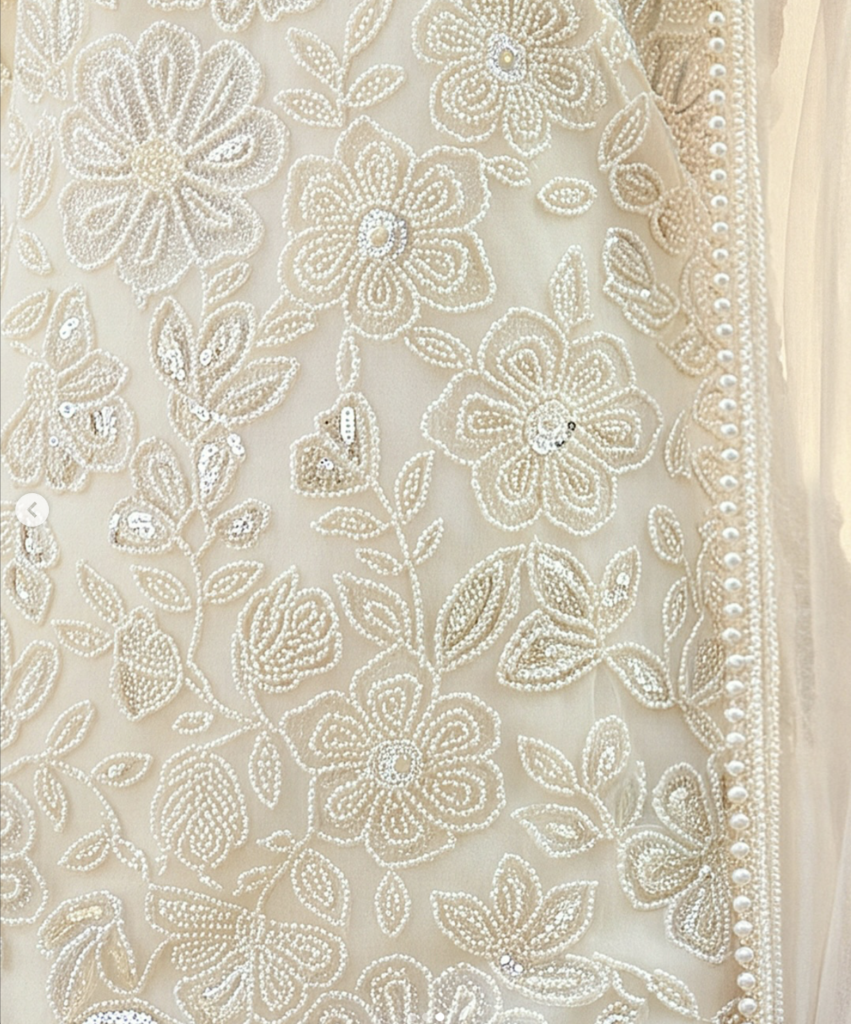
When you hold a piece of luxury embroidered textile like an ivory sheer base embellished with tonal floral motifs, pearl detailing, delicate sequins, and precise stitchwork you are looking at much more than thread and fabric.
You are looking at a series of calculated decisions.
To the untrained eye, a premium fabric represents color, shine, and visual appeal. To a manufacturer, it represents material selection, yarn density, embroidery programming, machine calibration, hand finishing and multi stage quality control. Every pearl placement and subtle border stitch reflects a business philosophy: whether to cut corners to lower costs or to invest in precision to build lasting value.
Surat has long been the powerhouse of India’s textile ecosystem. However, if our industry is to lead the next decade of Indian fashion, we must learn the lesson embedded in high grade fabrics : true luxury cannot be built on price competition alone.
Section 1 : The Challenge of Price Driven Competition
Surat has built an extraordinary industrial machine. With over 500 textile mills, 1,000+ processing units, tens of thousands of weaving operations, and a vast network of wholesale markets, our city processes tens of millions of meters of fabric daily. NITI Aayog’s economic master plan notes that around 95% of the region’s textile enterprises operate as MSMEs.
However, this immense scale has historically leaned toward a high volume, low margin model. When businesses compete strictly on price
- Margins are Compressed : Reduced profitability leaves little room to reinvest in research, design or modern technology.
- Design is Replicated : Instead of developing original concepts, companies rush to imitate existing market hits, leading to market saturation and price degradation.
- Quality is Compromised : Base fabrics become lighter, thread counts drop and finishing standards suffer to save a few rupees per meter.
- Credit Cycles Stretch : Price dependent suppliers often accept extended receivables and long credit terms, putting severe pressure on working capital.
Price competition creates a race to the bottom. To build resilient, future ready enterprises, Surat’s manufacturers must shift their focus from volume output to value creation.
Section 2 : What Makes a Fabric Premium?
A fabric does not become premium simply because a higher price tag is attached to it or because it is heavily embellished. True premium quality is defined by specific, manageable elements:
┌──────────────────────────────────────────┐
                  │    ELEMENTS OF A PREMIUM TEXTILE        │
                  └────────────────────┬─────────────────────┘
                                       │
     ┌───────────────────┬─────────────┴─────────────┬───────────────────┐
     ▼                   ▼                           ▼                   ▼
Base Fabric Integrity  Design Balance       Precision Workmanship  Finishing & Hand-Feel
(Pure silks, tissue,  (Proportion, palette,  (Thread tension, bead  (Drape, edge-stitching,
 organza, georgettes)  subtle embellishment)  registration, durability)  color fastness)
Base Material Integrity : The foundation dictates everything. High grade tissue silks, fine organzas, pure georgettes, and premium chiffons provide the drape, breathability and structural strength required to support intricate embroidery without tearing or warping.
- Design Balance & Restraint : Modern luxury favors restraint. Knowing what not to add is as important as adding embellishment. Well proportioned floral motifs, harmonious color palettes and elegant borders elevate a fabric far more than dense, heavy ornamentation.
- Precision Workmanship : Whether executed via advanced multi-head machinery or delicate handwork Khatli, Zardozi, pearl setting, execution must be flawless. Stitch tension must be uniform, motifs aligned and embellishments securely anchored.
- Consistency & Finishing : Premium manufacturing guarantees that meter 1 and meter 100 in a production run are identical in color, feel and quality.
Section 3 : Surat’s Manufacturing Advantage
Surat possesses an industrial supply chain that few textile hubs globally can mirror. Within a compact geographical radius, an enterprise can access:
{Yarn Sourcing} {Weaving} {Dyeing \& Processing} {Digital Printing} {Embroidery} {Garmenting} {Logistics}
Events like the Surat International Textile & Machinery Expo SITME showcase cutting edge embroidery automation, single head Zardosi setups, and high speed beadwork machinery running at up to 1,800 RPM.
However, having an ecosystem is merely an environment knowing how to orchestrate it with discipline is the real competitive advantage. By connecting advanced machinery with skilled craftsmanship, local manufacturers can rapidly prototype, refine and scale complex, high value textiles.
Section 4 : The Importance of Original Design & Privacy
In a high speed manufacturing hub, original design is a crucial business asset. Relying on screenshot copying yields short term gains while destroying long term pricing power.
A modern premium manufacturer must invest in an authentic R&D cycle
{Trend Research} {Concept Interpretation} {Material Development} {Prototyping} {Market Testing}
Protecting Design Privacy
Because developing an original seasonal line requires significant capital investment, design confidentiality is critical
- Restricted Sampling Access : Limiting physical sample exposure prior to launch.
- Internal IP Protocols : Enforcing non disclosure agreements across CAD designers, punching masters and production floors.
- Digital Asset Security : Managing technical packs and motif files securely.
In the premium fashion landscape, original design creates market differentiation, while design privacy protects profitability.
Section 5 : Management Is the Foundation
A beautiful design concept cannot sustain a business without strong management systems. Executive leadership must coordinate every operational tier
Management Domain Strategic Focus Operational Metric Design Management Original R&D, trend analysis, color forecasting Proprietary Revenue Financial Discipline Receivables control, working capital oversightCash Conversion Cycle Days Quality Systems In line inspections from raw fabric to packaging Defect & Return Rate Production Planning Line balancing, lead time reduction On Time Delivery Brand Positioning Moving from white label supply to direct identity Customer Retention Rate
At Kimora Fashion and Nari Design, our management philosophy centers on this balance: uniting Surat’s industrial capacity with proprietary design protection, material standards, and disciplined cash flow management.
Section 6 : Building the Next Generation of Indian Fashion Businesses
The modern Indian consumer especially millennial and Gen-Z buyers is reshaping market demand. They seek lightweight luxury, fluid drapes, contemporary color palettes and versatile ethnic wear suited for global celebrations.
To serve this changing market, manufacturers must evolve along three key dimensions:
Volume Supply           ───►   High-Value Brand Equity
Trader Dependence       ───►   Direct Customer Relationships
Price Competition       ───►   Product Differentiation & Quality
By focusing on original design, material quality, and customer trust, Indian fashion manufacturers can build enduring brand equity both domestically and internationally.
Conclusion : Vision for the Industry
Surat’s future in premium fashion will not belong solely to those who install the newest machinery or produce the highest volume. It will belong to leaders who combine technology with craftsmanship, trends with originality, production speed with strict quality control and scale with disciplined management.
Our city has built one of the world’s most formidable textile hubs. Our responsibility as the next generation of industry leaders is to manage that ecosystem with vision, protect our creative investments, and showcase world class Indian fashion to the global market.
About the Author
Mahesh Choudhary is the Managing Director of Nari Design Premium Saree. With over 13 years of experience in India’s textile and ethnic wear industry, he focuses on premium fashion manufacturing, design R&D, quality management systems and strategic growth within Surat’s textile ecosystem. Through his writing, he shares insights on building disciplined, design led fashion enterprises in India’s evolving textile economy.