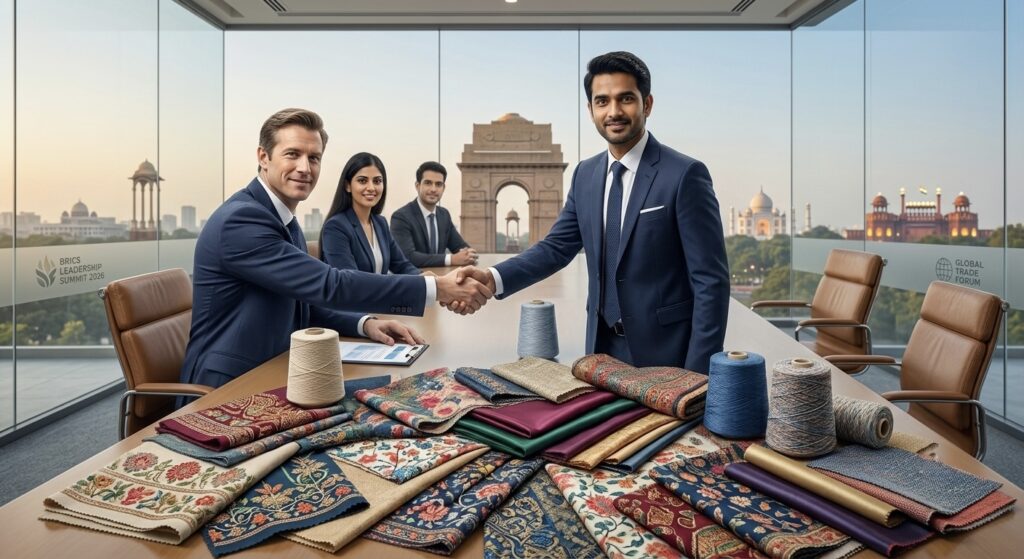
From financial discipline and original design to workforce management, technology, and global sales why Surat’s next generation of premium saree manufacturers must think like global businesses.
By: Mahesh Choudhary, Managing Director, Nari Design Premium Saree India
BRICS Is About More Than Geopolitics
As the 18th BRICS Summit unfolds in New Delhi, leaders from major emerging economies are convening to discuss resilience, innovation, trade diversification, and economic cooperation. For most observers, this is a lesson in global politics. As a Managing Director in Surat’s premium saree manufacturing industry, I don’t look at BRICS only as an international political or economic forum. I look at it as a reminder that businesses from emerging markets must become stronger, more resilient, and more professionally managed.
BRICS and the New Opportunity for Indian Manufacturers
Global trade relationships are shifting, supply chain resilience is paramount, and emerging markets are claiming greater economic space. India has a generational opportunity to transition from being an outsourced supplier to a global brand powerhouse. However, global opportunity does not automatically create global businesses. Management capability converts opportunity into business.
Surat Already Has What the World Needs
Surat possesses an unmatched textile ecosystem: Yarn Weaving Dyeing Processing Digital Printing Embroidery Handwork Garmenting Finishing Packaging Logistics. We excel in synthetic fibers, value addition, and sheer manufacturing speed. Surat doesn’t have a manufacturing problem; Surat has a differentiation and management opportunity.
The Next Surat Textile Revolution Is Premium Manufacturing
For decades, Surat won on scale, speed, and competitive pricing. The future belongs to originality, brand value, limited production, and customer experience. The future of Surat’s textile industry cannot be only about how many pieces we produce. It must increasingly be about what value each piece creates.
What “Premium Saree Manufacturing” Actually Means
At Nari Design, premium is not simply an elevated price tag. It is a comprehensive standard:
- Superior Fabrics: Curating high grade organza, tissue silk, pure silk, georgette, and chiffon.
- Originality & Intelligence: Moving past competitor copying through trend forecasting.
- Precision & Protection: Enforcing strict quality control, detailed embroidery, controlled production, design confidentiality, and reliable delivery.
My First Management Principle: Financial Discipline
A company can have beautiful products and strong sales and still become financially weak. Revenue is not the same as financial health.
Managing working capital, inventory levels, supplier cycles, and product-level profitability determines long term survival. For me, financial management is not the job of the finance department alone. It is a management responsibility.
My Second Management Principle: Design Is an Investment, Not an Expense
Before we manufacture a premium saree, we invest in an idea. Investing in 15+ dedicated designers, color development, and original embroidery creates defensible brand equity. In premium fashion, copying a successful product may generate short-term sales, but original design creates long term brand value.
My Third Management Principle: People Are Part of the Product
A premium saree cannot be manufactured by a machine alone. It is manufactured by a coordinated human system. From designers and production teams to handwork artisans and quality managers, workforce planning and skill development directly dictate the final finish of the product.
Management Means Connecting Every Department
A successful manufacturing enterprise relies on seamless integration across the entire chain:
Design Finance Raw Material Production Embroidery Quality Sales Logistics Customer
My role as Managing Director is not to perform every job. My role is to make sure every important job is connected.
Sales Should Not Control Manufacturing
Many manufacturers let market demands dictate erratic production. The disciplined flow must be: Market Information Design Intelligence Controlled Production Sales. Sales should tell us what the market wants. It should not force us to destroy our production discipline.
The Payment Cycle Problem in Surat
Surat’s traditional reliance on high volume, excessive credit, long payment cycles, and unmanaged inventory leaves manufacturers vulnerable to cost spikes. Moving to a controlled, premium production model mitigates working-capital pressures and reduces reliance on discount-driven trader networks.
Why Limited Production Can Be a Strength
Luxury is not always about producing more. Sometimes luxury is about producing less but better. Limited collections build exclusivity, protect margins, improve inventory discipline, and foster direct customer relationships.
From Textile Manufacturing to Fashion Manufacturing
Selling finished, branded apparel yields far higher value than supplying raw fabric. Surat must complete the transition: Fabric Product Brand Global Customer.
Technology Will Change Premium Saree Manufacturing
ERP systems, digital printing, and AI driven trend forecasting streamline production and logistics. However, technology should not replace creativity. Technology should give creativity better tools.
From Surat to the World
BRICS represents a broader conversation about emerging-market cooperation. For Indian manufacturers, the larger lesson is to build products and companies capable of participating in global markets from the Middle East and Southeast Asia to the global diaspora.
Nari Design: A Practical Management Experiment
Drawing on over 13 years of manufacturing experience, Nari Design is my experiment in building a professionally managed premium fashion manufacturing company from Surat backed by an in-house ecosystem of 500+ employees, digital printing, detailed handwork, and modern distribution.
The Blueprint for Future Surat Manufacturers
Traditional FocusFuture Manufacturer Framework Copy-driven volume Design driven exclusivity Credit dependent cash flow Financial discipline & fast cycles Labor-dependent assembly Workforce oriented skill systems Trader dependent selling Brand conscious direct relationships Purely domestic reach Export ready & global standard
Surat Can Become a Global Fashion Manufacturing Hub
The question isn’t “Can Surat manufacture ?” It clearly can. The question is “Can Surat create global fashion companies ?” Yes if we combine manufacturing strength with management strength.
Closing: From BRICS to Surat
As leaders meet in New Delhi to shape the future of emerging economies, the key imperative for Indian manufacturers is clear: we must be more innovative, financially disciplined, design focused, and global. BRICS may discuss the future of emerging economies. At our level, we have to build that future factory by factory, design by design, employee by employee, and product by product. For me, the future of Surat’s saree industry is not about producing more. It is about managing better, designing better, and building something the world wants to buy.