A Managing Director’s perspective and vision on building an elite premium saree brand in Surat where creativity, craftsmanship, technology, financial discipline, and people management must work together.
1. Premium Is Not About Adding More. It Is About Knowing What to Balance.
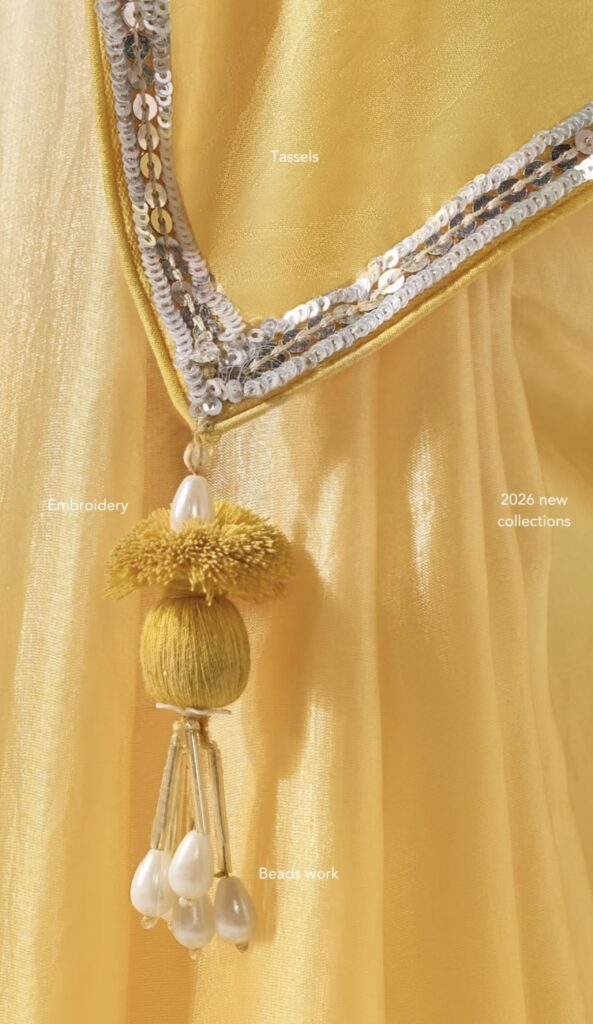
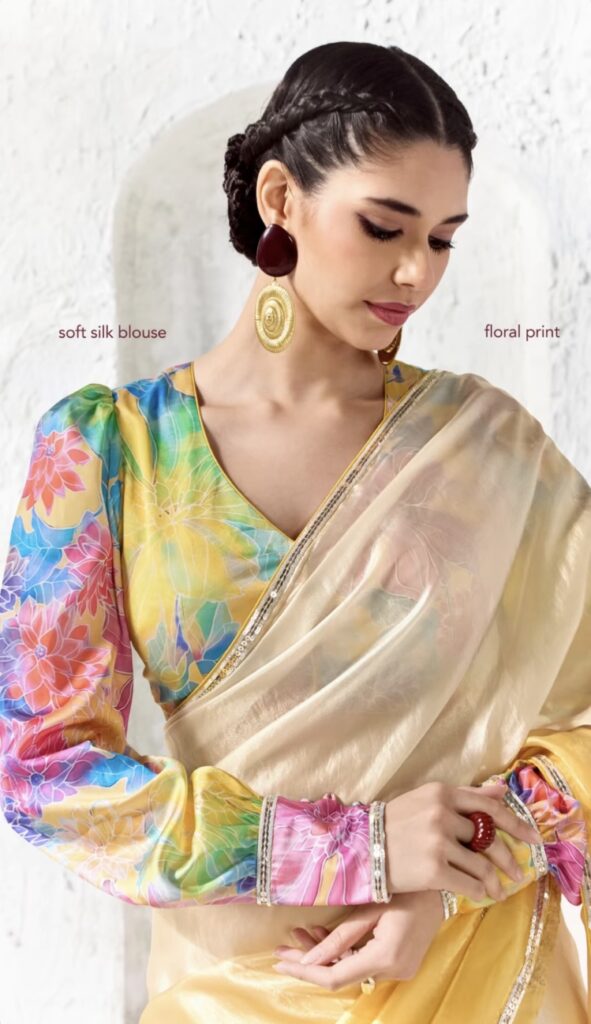
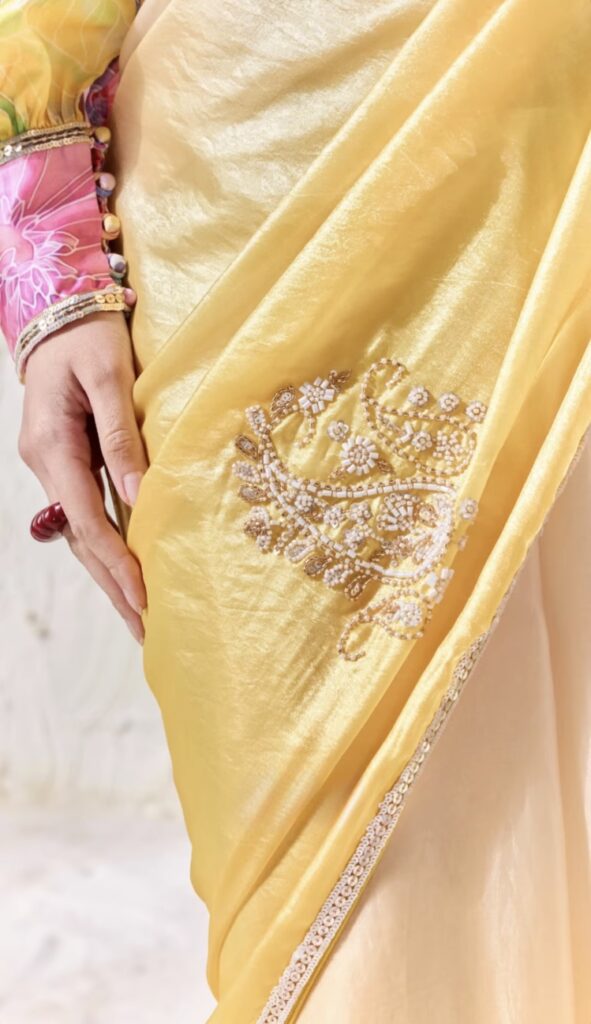
Look closely at a single piece from a modern collection and you will notice a tapestry of techniques: vibrant digital floral printing on a soft silk blouse, an elegant pale-yellow drape, intricate white bead motif work, sequin trims, hand-tied tassels, and structured border work.
When looking at a design, the real question isn’t: “How many techniques can we put into one saree?”
It is: “How do we combine different techniques without losing elegance?”
This distinction forms the central philosophy of executive leadership in fashion manufacturing. Premium design is not a practice of accumulation; it is an exercise in restraint, balance, and intentionality.
2. My Vision: Premium Manufacturing From Surat
Surat is universally recognized as a powerhouse of textile manufacturing. Its reputation is built on formidable strengths:
- Mass production scale
- Rapid turnaround speed
- High-volume output
- Vast material variety
- Competitive pricing models
- Deep industrial textile expertise
However, my objective was not to build a business centered solely on volume. My vision was to establish a premium brand position rooted in Surat one where value is defined by a precise equation:
{Design} {Quality} {Craftsmanship} {Management}{Consistency} {Premium Value}
To transition from a commodity manufacturer to an elite brand leader requires shifting focus from maximum output to uncompromising value creation.
3. The Design Philosophy: Smart Work, Not Just Hard Work
True luxury does not require covering every square inch of fabric with heavy embroidery or manual labor. Instead, our leadership and creative teams analyze every garment strategically:
- Digital Printing: Where can high-definition prints deliver visual freshness without adding physical weight?
- Embroidery: Where should a focused motif create a compelling visual anchor?
- Handwork: Where does manual artisan detail add tangible exclusivity?
- Fabric Dynamics: Where should the raw texture of the fabric be allowed to breathe naturally?
- Color Harmony: How do contrasting palette elements complement rather than compete with each other?
Premium design is not about doing more work. It is about doing the right work in the right place.
4. Reading the Saree Like a Canvas
As leaders, we must view our products through both an artistic and an operational lens.
- The Complete Vision: A vibrant floral print blouse pairs with a soft, flowing yellow drape to establish immediate visual harmony and contemporary appeal.
- The Craftsmanship: Zooming in reveals a concentrated, handcrafted paisley embellishment using delicate white beads and embroidery creating a focused point of luxury.
- The Execution: Looking closer at the border work reveals high-precision sequin piping paired with custom pearl beaded tassels, proving that quality holds up under scrutiny.
A customer sees a beautiful saree. As a Managing Director, I see hundreds of micro-decisions behind it.
5. Technology and Craftsmanship Should Work Together
The debate between modern automation and traditional handcrafting is a false dichotomy. Elite manufacturing leverages both:
DimensionRole of Modern TechnologyRole of Traditional CraftsmanshipPrimary OutputDigital precision, vibrant color reproduction, rapid prototyping, contemporary pattern flexibility.Tactile dimension, organic texture, distinct individuality, luxury depth.Value ContributionSpeed, consistency, and structural scalability.Heritage, character, human connection, and exclusivity.
Technology gives us possibilities. Craftsmanship gives the product character. Management brings both together.
6. The Most Difficult Balance: Creativity vs. Cost
Every design choice carries a direct financial outcome. Indiscriminately layering handwork, custom dye techniques, premium sequins, and long development cycles inflates production costs rapidly.
The core managerial challenge is clear: How do we create maximum premium value without generating unnecessary cost?
Building a luxury brand requires relentless financial discipline. Management must continuously recalibrate four interconnected vectors:
{Design Ambition} {Production Cost} {Selling Price}{Customer Value}
7. Finance Is Part of Creativity
Finance and creativity are often treated as opposing forces, but in sustainable manufacturing, financial boundaries sharpen creative focus.
When a designer proposes an elaborate accent or technique, management must evaluate: “Does this detail enhance the customer’s perception of value enough to justify the additional cost?”
This evaluation does not suppress creativity it makes creative work commercially viable and repeatable. A premium brand cannot survive on creativity alone. Creativity needs financial discipline behind it.
8. People Are the Most Important Part of Premium Manufacturing
A fine garment is never the accomplishment of a single leader or designer. It represents the synchronized effort of a multi disciplinary team:
- Designers who conceptualize balanced layouts.
- Embroidery Teams & Artisans who execute intricate detailing with patience.
- Production Staff who maintain material integrity through processing.
- Quality Controllers who inspect every inch against strict standards.
- Supply Chain & Office Teams who ensure raw materials and final deliveries move on schedule.
When looking at a finished piece, leadership sees more than fabric and thread it sees the collective skill, time, and dedication of the people behind it.
9. My Role as Managing Director: Connecting the Dots
Leadership is not about micro-managing every operational detail; it is about ensuring cross-functional alignment across the entire value chain:
{Design} {Production} {Quality} {Finance} {People} {Delivery} {Customer Experience}
Management is not controlling every department. It is creating seamless alignment between every department.
10. Quality Cannot Depend on One Person
As an enterprise scales, relying on isolated individuals for quality control becomes a single point of failure. Excellence must be institutionalized into the organizational culture through:
- Standardized Operating Procedures: Clear benchmarks for fabric tension, stitch density, and print calibration.
- Multi Stage Inspection Points: Checking raw fabric, post-print quality, post-embroidery stability, and final finishing.
- Structured Training Programs: Continuous skill development for shop-floor technicians and artisans.
- Accountability & Communication Loops: Clear feedback mechanisms between quality inspectors and design teams.
Systemic quality builds a brand that customers can trust consistently.
11. The MD’s Job Is to Think Beyond Today’s Order
Operations focus on completing today’s production run. Strategic leadership focuses on positioning the organization five years into the future.
Managing Directors must consistently evaluate long term variables:
- Brand Positioning: Elevating market perception above commodity pricing pressure.
- Capability Building: Investing in advanced digital machinery and craft development.
- Financial Stability: Maintaining healthy margins and working capital resilience.
- Market Expansion: Exploring modern Indian ethnic wear trends and international export channels.
12. When the Market Says “Lower the Price,” Vision Says “Improve the Value.”
When facing price competition or market downturns, the easiest route is to cut costs and compromise on material quality. However, long-term brand equity is built by resisting this temptation.
When market pressure signals price reduction, true leadership focuses on elevating total value:
{Design Excellence} {Material Quality} {Reliable Service} {Uncompromised Value}
13. My Management Formula for Premium Manufacturing
Maintaining an elite brand identity requires balancing every critical component in equal measure:
{Premium Brand} {bmatrix} {Vision} {Design} {Quality} {Smart Technology} {Craftsmanship} {People} {Financial Discipline} {Management Consistency} {bmatrix}
Remove any single variable from this equation, and long-term premium positioning collapses.
14. What I Have Learned as a Managing Director
- Quality takes patience: Shortcuts in fabric preparation or finishing always show in the final product.
- Creativity needs commercial discipline: Unfunded creativity is unsustainable; disciplined creativity builds legacies.
- Employees are capability, not overhead: Skilled craftsmanship is a core strategic asset.
- Technology supports craft: Modern tools enhance efficiency, but human skill provides character.
- Consistency defines premium: A single remarkable collection is a draft; consistent execution across years builds a brand.
- Management is balance: Leadership is the art of balancing competing priorities without losing focus.
- Vision guides compromise: A strong strategic vision prevents short-term decisions from undermining long term goals.
15. The Future: Building Premium From Surat for the World
The objective goes beyond growing sales metrics. It is about contributing to a modern Indian fashion manufacturing ecosystem one where Surat’s unmatched production capacity is paired with high level design intelligence, fine craftsmanship, modern technology, and disciplined business operations.
By strengthening production systems, investing in talent, and maintaining financial clarity, the goal is to build high end Indian textiles capable of competing on the global fashion stage.
The Saree Is the Result. The Vision Is the Beginning.
When someone views a premium saree, they notice the color, the fluid drape, the embroidery, and the immediate visual impact.
As a Managing Director, I see the complete ecosystem behind it: the designer who conceptualized the balance, the artisan who executed the beadwork, the technology that enabled precision printing, the financial planning that ensured commercial viability, and the strategic vision that refused to compromise on quality.
Premium manufacturing is not about doing everything. It is about balancing everything.
That balance is what we continue to build from Surat, for the future of Indian fashion.