By the Managing Director of Nari Design
1. A Beautiful Saree Is Only the Visible Part of a Much Bigger System
When a customer sees a premium saree, they see the final 10%. As a manufacturer, I see the 90% that happened before it reached her.
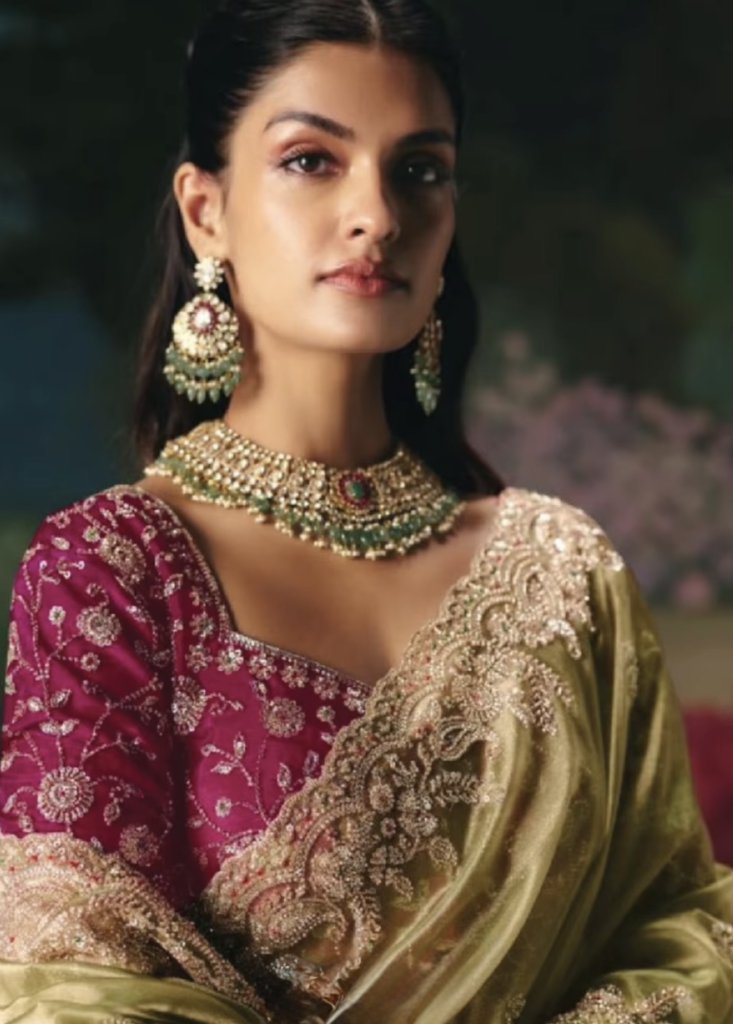
A customer looks at the garment and notices a rich olive gold sheen, intricate zardozi embroidery along the scallop cut border, a deeply embellished jewel toned blouse, and luxury finishing.
Design ➔ Fabric Selection ➔ Dyeing ➔ Printing ➔ Embroidery ➔ Handwork ➔ Blouse Tailoring ➔ Finishing ➔ QC ➔ Packaging ➔ Delivery
Behind every single link in that chain sit specialized machinery, skilled artisans, capital investments, and strict management decisions. The magic of high fashion isn’t just creative inspiration; it is logistical precision.
2. Surat Is Moving From Volume to Value
Surat earned its global reputation as a powerhouse of textile scale a city built on high speed mass production, unmatched variety, and razor thin competitive margins. But from my experience in Surat’s manufacturing ecosystem, I believe the premium segment is becoming increasingly important.
The modern market demands heavy designer sarees, bridal couture, and occasion wear that require an entirely different playbook:
- From speed alone to craftsmanship and detail.
- From standardized fabric to custom design development.
- From spot checks to multi stage quality control.
Surat has already mastered scale. The next opportunity is to master premium value at scale.
3. My Vision Was Never Just to Manufacture More
When building Nari Design, the objective was never to run a race to the bottom on price or produce sheer volume at the expense of character. My vision was to build a sustainable, recognized premium brand.
To do that, our operational priorities had to shift:
- Differentiated Design: Creating distinctive collections rather than chasing short lived market clones.
- Uncompromising Quality: Refusing to let production speed ruin fabric integrity or embroidery precision.
- Thoughtful Craftsmanship: Balancing machine embroidery with traditional handwork for depth and texture.
- Consistency: Ensuring saree #100 in a production run matches the exact quality of saree #1.
4. Why I Believe Vertical Manufacturing Is the Future
Traditionally, fashion manufacturing in textile hubs is fragmented. A fabric comes from one vendor, gets dyed across town, moves to an embroidery unit, travels elsewhere for hand embellishment, and ends up in another workshop for finishing.
Instead of depending on disconnected external units, the future belongs to an integrated ecosystem under one roof:
[ Design Development ]
         │
         ▼
[ Fabric & Thread Selection ]
         │
         ▼
[ Digital Printing & Embroidery ]
         │
         ▼
[ Artisan Handwork & Embellishment ]
         │
         ▼
[ Blouse Stitching & Finishing ]
         │
         ▼
[ Final Quality Control & Packaging ]
This structural shift grants absolute control over design execution, delivery timelines, and build quality.
5. One Roof Creates One Standard
When production stages are scattered across multiple third-party contractors, management faces constant friction: miscommunicated color codes, mismatched thread dyes, missed delivery deadlines, and shifting quality standards.
“Premium quality becomes easier to protect when the people responsible for different stages are working within the same system and toward the same standard.”
When your embroidery team works in the same ecosystem as your handwork artisans and quality inspectors, misalignments are solved in real time rather than discovered after thousands of meters of fabric have already been processed.
6. The Real Advantage Isn’t Just Cost. It’s Control.
Vertical integration is often framed purely as a cost-cutting tactic. In luxury and premium fashion, cost reduction is merely a secondary benefit. The true driver is control.
Operational DimensionFragmented OutsourcingIntegrated ManufacturingQuality ControlReactive (after delivery)Proactive (at every stage)IP & Design ProtectionHigh risk of leakagesStrict internal confidentialityTrend AgilitySlow round trip coordinationRapid sampling & turnaroundsFinishing StandardVariable across batchesUniform & standardized
Control over these parameters allows a manufacturing business to remain agile without diluting brand prestige.
7. Designing a Heavy Saree Without Losing Elegance
Premium design is the result of hundreds of decisions fabric, colour, craftsmanship, proportion and finishing coming together with one vision.
Looking at a garment like the one above, it is easy to assume “more is better.” But in premium saree design, visual weight requires structural balance. Heavy does not mean excessive. Luxury comes from knowing where to add detail and where to leave space.
Notice the deliberate hierarchy in the piece:
- The Blouse: Richly detailed with structured embroidery to frame the face and shoulders.
- The Pallu & Border: Ornate scalloping and dense embellishment that catches light naturally.
- The Body: Elegant olive gold drape that gives the eye room to breathe, keeping the overall silhouette graceful rather than overwhelmed.
8. The Managing Director’s Work Begins Before Production
Executive leadership in textile manufacturing isn’t about standing over workers on the factory floor checking stitches. It begins long before the first machine is turned on:
- What will premium consumers value next season?
- Where should we apply digital machinery, and where is hand craftsmanship non-negotiable?
- Which fabric developments warrant capital investment?
- Can this high-concept design be executed at a commercially viable price point?
My responsibility is not to make every operational decision. My responsibility is to build the system that ensures the right decisions are made consistently.
9. Premium Manufacturing Requires Financial Discipline
Creative vision without financial discipline leads to operational failure. A premium product business cannot run on aesthetics alone; every intricate collection requires heavy upfront commitment:
{Total Investment} {Fabric Capital} {R\&D/Sampling} {Artisan Labour} {Inventory Holding} {Marketing}
As Managing Director, my role is to balance three competing forces:
- Creative Vision: What do we aspire to build?
- Financial Sustainability: What can we invest without overextending working capital?
- Market Viability: Will the final consumer recognize the intrinsic value of this price tag?
10. People Are the Engine of Vertical Integration
Machines provide scale, but human beings deliver craftsmanship. An integrated facility is only as strong as the alignment between its teams:
- Designers must understand the physical limits of embroidery machines.
- Machine operators must appreciate the artistic intent behind a drape.
- Quality checkers must respect the effort spent by handwork artisans.
Technology can connect departments, but people connect the entire company. Investing in fair practices, skill development, and a culture of craftsmanship is what turns a factory floor into a luxury atelier.
11. My Management Philosophy: Alignment Over Control
Micro management does not scale. As Nari Design grow, maintaining personal oversight over every meter of fabric becomes impossible and counterproductive.
Instead of rigid control, I focus on Alignment:
{VISION} {SYSTEM} {PEOPLE} {PREMIUM EXCELLENCE}
When teams are aligned on what premium means, why we enforce high standards, and how their individual role contributes to the final saree, quality control becomes self-sustaining.
12. From One Saree to an Entire Premium Manufacturing System
A single hit collection is good luck; continuous hit collections are the result of a robust system. The real ambition is to build a repeatable, scalable framework capable of turning raw ideas into market-ready luxury across multiple verticals from sarees and designer blouses to embroidered suits and bridal wear.
A premium brand cannot depend on occasional excellence. Excellence has to become a system.
13. What I Have Learned as a Managing Director
- Execution is Everything: Vision without disciplined execution remains a drawing on paper.
- Systems Guard Quality: Short cuts always cost more in the long run through ruined brand reputation.
- Control vs Capability: Vertical integration gives you control, but your people determine your capability.
- Art Needs Arithmetic: High fashion requires grounded financial management.
- Restraint is Luxury: Heavy embellishment requires space and balance to remain elegant.
- Brand equals Consistency: Trust is built over years of predictable quality, not a single good season.
- Dual Focus: The Managing Director must design tomorrow’s strategy while empowering the team to execute today’s production.
14. Where I See the Future of Surat’s Saree Industry
Surat will always remain the beating heart of India’s textile production. However, the market is entering a new phase:
{Mass Production} {Smart Production} {Integrated Premium Manufacturing}
The market leaders of the next decade won’t simply be those who can produce the highest volume at the lowest price. They will be the integrated manufacturers who successfully blend scale + design + craftsmanship + technology + management speed.
15. Build Premium, Not Just Produce Premium
My goal has never been simply to manufacture a beautiful saree. My goal is to build the capability, people, processes, and culture required to create beautiful sarees consistently.
That is why I believe vertical integration is more than a manufacturing strategy it is a brand strategy. When design, craftsmanship, technology, finance, and leadership move in harmony, a saree ceases to be just a piece of fabric. It becomes the physical expression of a complete vision.
Surat taught India how to manufacture at scale. The next chapter is teaching the world how India can manufacture premium fashion at scale.