By Managing Director’s Nari Design – Premium Saree India
1. I Don’t Start With a Saree. I Start With a Question.
A premium saree is not created when the embroidery machine starts. It starts much earlier with research.
Before we draft a single outline or select a palette, I ask my team one question: What will the premium customer want next?
Establishing a designer line requires stepping back from the immediate noise of the market. Our design process begins by decoding broader shifts:
- Market movements and economic shifts in high-end ethnic wear
- Wedding and occasion trends dictating seasonal drape styles
- Evolving color directions and palette preferences
- Fabric shifts, such as the move toward lightweight, high-drape textiles
- Embroidery and digital print innovations
- Consumer expectations around garment weight, comfort, and longevity
- Competitor positioning and gaps in the luxury segment
- Price to value equations that define true luxury
When you approach manufacturing from an MD’s perspective, research is not an auxiliary department it is the foundation of product development.
2. Surat Is Entering a New Phase of Saree Manufacturing
Historically, Surat built its reputation as an industrial powerhouse on four pillars: Scale, Speed, Variety, and Cost Efficiency. It is the undisputed hub for volume manufacturing.
However, the global Indian fashion ecosystem is evolving. There is a rapidly growing market for designer, heavy, high-value occasion sarees. Historically, specialized capabilities like ultra premium printing or elaborate hand-crafting were concentrated in regional markets like Kolkata.
Surat has already demonstrated that it can manufacture at an enormous scale. The next challenge is to create high value, designer grade products with that same manufacturing strength.
By building specialized capabilities directly into Surat’s integrated ecosystem, we bridge the gap between boutique design aesthetics and industrial execution.
3. My Vision: Bring the Entire Premium Product Under One System
To deliver true luxury consistently, you cannot rely on a fragmented supply chain where every process lives with a different vendor. My core operational philosophy is simple: Vertical integration is not about owning more processes; it is about having complete control over final quality.
We structure our internal workflow as a unified pipeline:
{Market Research} {Trend Analysis} {Design Development} {Fabric Selection}
{Digital Printing} {Embroidery} {Handwork} {Blouse & Trim Development}
{Finishing} {Quality Control} {Final Premium Collection}
When design, technical execution, and quality assurance operate under one vision, errors decrease, sampling speeds up, and the integrity of the design remains intact from draft to drape.
4. Design Doesn’t Begin With Embroidery
Embroidery is a technique. Design is knowing why, where, and how to use it.
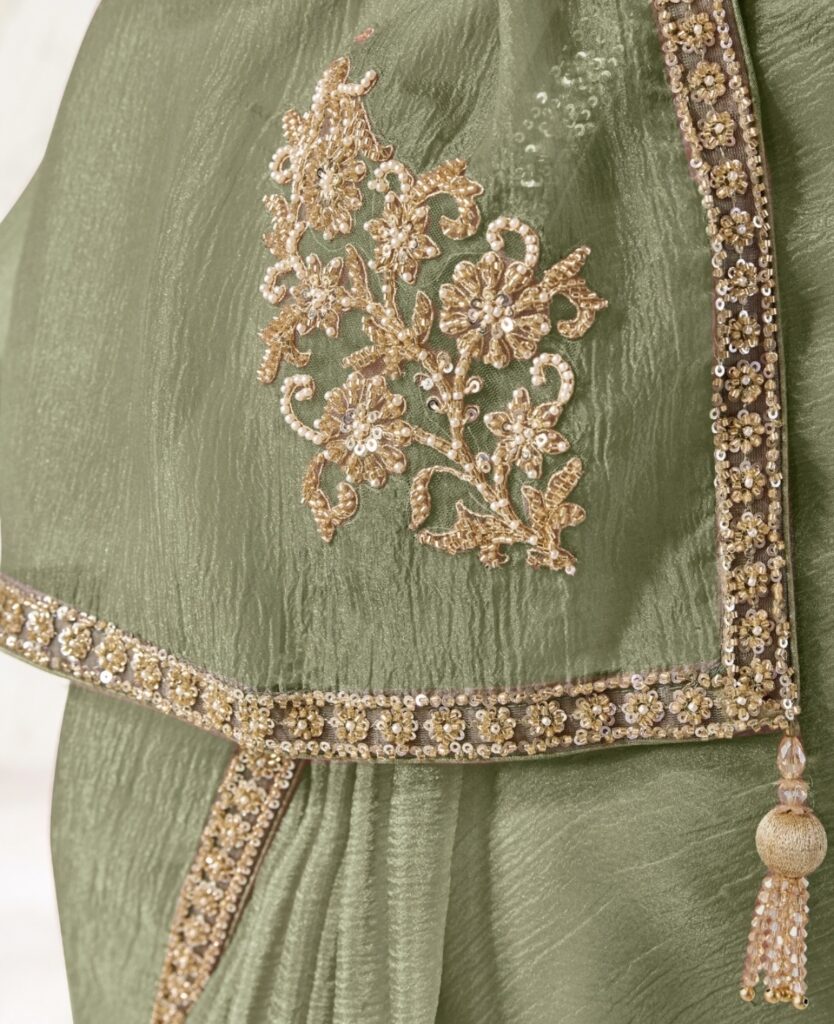
Consider a detailed floral motif designed for a high-end saree collection. Before production touches a machine or a craftsman’s frame, critical design decisions must be made:
- Scale & Placement: Where does the motif sit on the pallu versus the pleats?
- Density: How heavy should the stitch count be to maintain structural balance without weighing down the fabric?
- Material Composition: Which combination of zardozi threads, sequins, and micro-beads will capture light without feeling abrasive?
- Fabric Compatibility: How will the motif react to the fluid movement of a crushed or woven viscose sheer?
[ DESIGN THINKING ]
                 │
  ┌──────────────┼──────────────┐
  ▼              ▼              ▼
Motif Scale   Material Blend   Fabric Weight
  │              │              │
  └──────────────┼──────────────┘
                 ▼
       [ EMBROIDERY TECHNIQUE ]
This structural discipline separates superficial decoration from intentional design thinking.
5. From Handwork Aesthetics to Machine Precision
One of our primary technical focuses at Nari Design is translating the fluid beauty of hand craftsmanship into high precision machine embroidery.
This is not about cutting corners or replacing traditional artisans; it is about preserving the visual language of hand craftsmanship while improving repeatability, structural durability, and scalability.
Craftsmanship Pillar Handwork Machine PrecisionOur Integrated ApproachVisual TextureOrganic, slight variationsExact, uniform stitchesMachine base layer for structure; hand applied highlights for depth.Production Speed Highly labor intensiveHigh throughputFast execution of base motifs without losing detail.Consistency Hard to replicate identically across 100 pieces100% identical reproductionGuaranteed quality across multi-piece designer runs. Scalability Bottlenecked by manual capacityScalable to market demandCommercial viability without compromising on luxury appeal.
The objective is not to replace craftsmanship with technology. It is to use technology to make craftsmanship more consistent, scalable, and commercially viable.
6. Why Pure Viscose and Digital Printing Drive Our Strategy
In the luxury segment, drape and touch are just as critical as visual detail. High-grade viscose fabrics offer the fluid fall of silk combined with exceptional breathability.
When paired with modern high-definition digital printing, it opens up creative possibilities that were previously impossible:
- Complex multi tonal gradients and subtle background washes
- Hyper-detailed botanical and architectural artwork
- Rapid sampling cycles that allow us to test concepts in days rather than weeks
- Greater freedom to experiment with limited edition runs
Technology gives designers a larger canvas. The real skill is knowing what to put on it.
7. The Art of Combining Techniques
A modern high value saree is a composite of multiple disciplines:
{Digital Print} {Machine Precision} {Handwork Touch} {Targeted Embellishments} {Balanced Luxury}
However, luxury is not about throwing every available technique onto a single piece of fabric. Over-designing creates heavy, uncomfortable garments that lack cohesion.
Our studio follows a strict balance framework:
- If the digital print is intricate: Keep the embroidery minimal and focused along the border.
- If the focal motif carries heavy handwork: Keep the surrounding fabric clean to allow the motif to breathe.
- If the border carries visual weight: Balance it with delicate, sparse placement across the body of the saree.
Premium design is not about maximum work. It is about maximum impact with the right amount of work.
8. Market Research Is Part of My Design Department
Many creative brands separate the business office from the design studio. In my management structure, market intelligence directly feeds creative direction.
We continuously track:
- Real-time sell through data across retail partners
- Emerging color movements across global runways and regional celebrations
- Evolving fabric preferences for seasonal weddings
- Consumer price tolerance relative to garment complexity
Our development pipeline explicitly avoids trend copying:
{Observe} {Understand} {Adapt} {Improve} {Create}
Market research should tell us where the customer is going. Design should decide how we get there differently.
9. Connecting Creativity With Reality
The core responsibility of a Managing Director in fashion manufacturing is bridging the gap between artistic vision and operational viability.
When a designer brings an ambitious concept to the table, several competing priorities must be balanced:
- Design: “Can we push the boundaries of this aesthetic?”
- Production: “Can we execute this stitch density across production runs without tear away or pucker?”
- Finance: “Does the bill of materials hit our target gross margin?”
- Marketing & Retail: “Does the end customer immediately perceive the value of this price tag?”
{Managing Director Value Equation} {Design Vision} {Market Intelligence} {Manufacturing Discipline}{Commercial Sustainability}
Bringing these distinct functions into alignment ensures that high creative standards are matched by sound business execution.
10. Premium Does Not Mean Unlimited Cost
High quality does not require an unchecked budget. Sustainable luxury manufacturing requires strict cost discipline across every variable:
- Raw fabric yields and waste reduction
- Machine run times and thread breakage efficiency
- Strategic allocation of handwork vs. machine hours
- Inventory turns on core base fabrics
Our goal is not to produce the most expensive saree on the market. It is to maximize both perceived and actual value for the customer within a sustainable cost structure.
11. Vertical Integration Eliminates Operational Friction
When design, digital printing, embroidery, handwork, and finishing are fragmented across external suppliers, communication breaks down. A delay in printing cascades into handwork bottlenecks, and quality issues are discovered too late in the process.
Under a unified vertical system:
- Design tweaks are made directly on the floor during live sampling.
- Fabric tensions are adjusted immediately between printing and embroidery stages.
- Quality standards are enforced at every step, not just at final packing.
- Lead times from concept to market distribution are significantly reduced.
The closer our design, technology, craftsmanship, and management work together, the faster we can turn an idea into a premium product.
12. People Are Still More Important Than Machines
No amount of advanced machinery can replace human skill and oversight. Advanced multi head embroidery systems and high speed digital printers are only as good as the teams operating them.
Our operational strength relies on a coordinated team:
- Textile & Graphic Designers conceptualizing artwork
- Digitizers & Machine Operators programming precise stitch angles
- Master Artisans executing delicate hand-embellishments
- Textile Technologists managing print consistency and fabric finish
- Quality Supervisors auditing every meter before release
A machine can repeat a design. It cannot decide what deserves to be designed.
13. Strategic Work Happens Before Production Begins
The visible output of a fashion business is the final garment. However, the work of executive leadership happens long before a collection reaches the market:
- Analyzing market dynamics to identify emerging opportunities
- Capital allocation toward high-precision machinery and fabric development
- Structuring teams that bridge creative talent and technical expertise
- Setting quality standards that protect brand equity
- Building the infrastructure for the next season while executing the current one
14. The Future of Saree Manufacturing in Surat
The next era of saree manufacturing in Surat will be defined by a shift from pure volume to design-led industrial discipline:
- Traditional craftsmanship will remain a key element of luxury products.
- Advanced machine embroidery will handle increasingly complex handwork aesthetics.
- Digital printing technology will allow for unprecedented detail and customization.
- Vertical integration will become necessary to manage operational complexity.
- Data driven market research will guide creative development earlier in the process.
The future belongs to manufacturers who can balance creative vision with industrial precision.
15. Building a Capability, Not Just a Factory
When I look at a premium saree, I see more than silk, thread, or print. I see market research, design decisions, machine engineering, hand craftsmanship, and financial discipline coming together in a single garment.
My vision for Nari Design goes beyond expanding physical footprint or throughput capacity. Our focus is building a permanent capability an integrated system that reliably transforms market insight into refined fashion products.
That is the future of premium saree manufacturing in Surat: learning how to design better, manufacture smarter, and create lasting value.
The future of this industry will not be decided by who can produce the most. It will be decided by who can turn an idea into a premium product with speed, consistency, craftsmanship, and vision.