By Mahesh Choudhary
Managing Director, Nari Design Premium Saree India
1. Visual Analysis: A Dual Architectural Tapestry
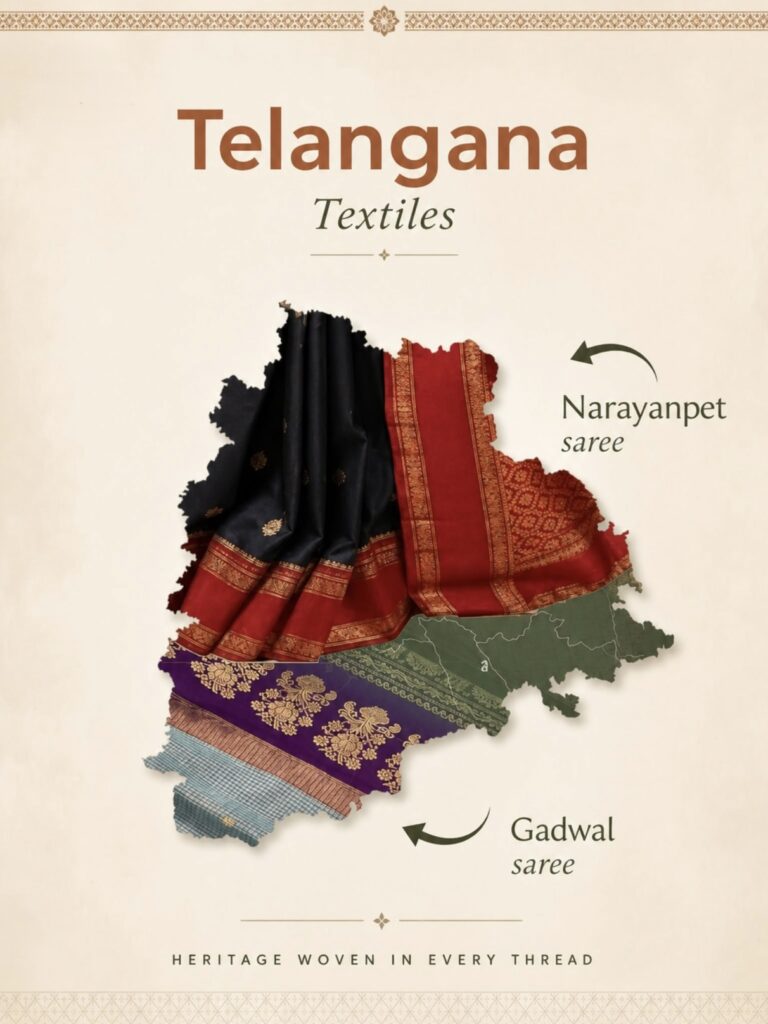
When you examine the geographic contour of Telangana overlaid with its two defining textile traditions the Narayanpet saree in the north and the Gadwal saree in the south you are observing a masterclass in structural contrast.
Look closely at the upper quadrant: a deep midnight-black field meet a structured, ruby red contrast border lined with classic geometric zari checks and temple motifs Gopuram. This is the signature of Narayanpet bold, disciplined, and rooted in functional dignity.
Now shift your gaze to the lower quadrant: an opulent royal purple silk pallu intricately decorated with golden floral medallions Buttas, seamlessly joining a finely woven body. That is the hallmark of Gadwal luxurious, intricate, and celebrated for its ingenious interlocking weave.
The bottom line sums up the philosophy: Heritage Woven in Every Thread.
As an executive directing large scale premium manufacturing in Surat, this image is not merely a graphic of cultural history. It is a strategic blueprint. It illustrates how two vastly different design philosophies can coexist within a single state boundary, offering a profound lesson on portfolio diversification, structural integrity, and brand identity.
2. Fact Checking & Technical Heritage of Telangana Textiles
To derive meaningful manufacturing insights, we must first verify the authentic technical foundations and historical timelines of these two iconic regional crafts.
┌─────────────────────────────────────────────────────────────────────────────┐
│                    TELANGANA TEXTILE HERITAGE STANDARDS                     │
├─────────────────────────────────────────────────────────────────────────────┤
│ 1. NARAYANPET SAREE                                                         │
│    • Historical Origin: ~1630 AD during Maratha ruler Chhatrapati Shivaji's │
│      campaigns, when Maratha weavers settled in Narayanpet region.          │
│    • GI Status: Registered under Geographical Indication (GI) Act.          │
│    • Core Characteristics: 80s count fine cotton/silk, double-warp contrast│
│      dobby borders, classic temple motifs, and vegetable/earth-tone dyes.   │
│                                                                             │
│ 2. GADWAL SAREE                                                             │
│    • Historical Origin: Early 19th century under local rulers (Samsthanams) │
│      and patronage of the Nizam of Hyderabad.                               │
│    • GI Status: Granted GI Status in 2010.                                 │
│    • Unique Craftsmanship: "Kupadam" / "Kutu" interlocking technique       │
│      joining a lightweight cotton body with a rich silk border & zari pallu.│
└─────────────────────────────────────────────────────────────────────────────┘
- Narayanpet The Maratha Legacy: Legend and historical records trace Narayanpet weaving back to around 1630 AD, when Chhatrapati Shivaji’s army marched through the Deccan plateau. Artisans traveling with the camp settled in the region, fusing Maratha weave aesthetics with local cotton traditions. Narayanpet sarees are celebrated for their 80s count high density yarns, crisp contrast borders, double warp lattice dobby construction, and exceptional colorfastness.
- Gadwal The Interlocking Innovation: Originating under the royal patronage of the Gadwal Samsthanam rulers and later championed under the Nizam era, Gadwal earned its formal GI status in 2010. Its hallmark technique is Kupadam an intricate manual jointing method where a breathable, lightweight cotton body is intertwined warp-by-warp with a heavy silk border and gold zari pallu. So fine was the traditional body weave that historic accounts noted a full cotton Gadwal could be folded to fit inside a matchbox.
3. What Narayanpet & Gadwal Teach Modern Saree Enterprises
In the modern fashion market, many brands attempt to be everything to everyone, resulting in diluted collections and forgettable designs. Telangana’s twin heritage teaches us the exact opposite: clarity of identity creates lasting market authority.
THE TWO STRATEGIC PILLARS

   THE NARAYANPET LESSON                       THE GADWAL LESSON
  (Structural Discipline)                    (Hybrid Material Engineering)
┌───────────────────────────┐              ┌───────────────────────────┐
│ • Clean, geometric lines  │              │ • Seamless material fusion│
│ • Unbeatable durability   │      vs      │ • Contrast in weight/sheen│
│ • Everyday sophistication │              │ • Ceremonial grandeur     │
│ • Utility meets elegance  │              │ • Interlocking precision  │
└───────────────────────────┘              └───────────────────────────┘
When we analyze why these weaves have survived for centuries, two lessons emerge for modern saree manufacturers:
- Utility is as valuable as opulence. A saree does not need heavy 3D embroidery to be premium. Narayanpet proves that perfect yarn twist, clean border ratios, and breathable comfort create loyal customers who wear the garment for hours without fatigue.
- Hybrid engineering solves consumer friction. Gadwal solved a timeless problem: women wanted the royal look of heavy silk for ceremonial events, but hated the heat and weight. By joining a light cotton body to a lavish silk zari border, traditional weavers invented the ultimate hybrid saree long before modern fashion schools coined the term.
4. Complementary Ecosystems: Handloom Heritage & Surat Manufacturing
A persistent misconception in fashion media is that modern industrial textile hubs like Surat stand in opposition to traditional handloom clusters.
As an executive leading large scale manufacturing and export operations from Surat, I see a deeply symbiotic relationship between these two worlds:
TELANGANA HERITAGE CLUSTERS                   SURAT MANUFACTURING HUB
┌─────────────────────────────────┐           ┌─────────────────────────────────┐
│ • Centuries of motif language   │           │ • High-speed Jacquard accuracy  │
│ • Master-weaving interlocking   │     +     │ • Scalable yarn dyeing systems  │
│ • Uncompromising material purity│           │ • Global export logistics reach │
└─────────────────────────────────┘           └─────────────────────────────────┘
                                  │
                                  ▼
                SUSTAINABLE GLOBAL PREMIUM FASHION
Telangana provides the artistic soul, geometric proportions, and timeless border language. Surat provides the modern machinery, high-precision yarn processing, computerized color consistency, and global supply chain logistics required to make these aesthetics available across international markets.
When modern machinery is operated with respect for heritage proportions, technology does not degrade culture it elevates its reach.
5. Executive Leadership & Manufacturing Philosophy
Building a globally recognized premium brand like Kimora Fashion Pvt. Ltd. and Nari Design requires visionary management that bridges creative art with cold industrial discipline.
A modern Managing Director must drive seven core operational pillars:
[1. Consumer Intelligence]  ──► [2. Original Artwork IP]  ──► [3. Premium Yarn Sourcing]
                                                                          │
  [6. Zero-Defect QC Standards] ◄── [5. Production Discipline] ◄── [4. Advanced Machinery]
           │
           ▼
  [7. Design Privacy Protocols] ──► [Workforce Care & Fair Wages] ──► [Global Distribution]
1. Protecting Design IP & Brand Privacy
In the fast-moving fashion market, low-quality knockoffs threaten genuine innovation. At Nari Design, we treat artwork with strict confidentiality. Every weave layout, digital print, and border schematic is kept encrypted and protected under strict IP protocols until market launch, ensuring our B2B partners and retail buyers receive 100% exclusive designs.
2. Investing in Advanced Machinery
To achieve the razor-sharp border precision seen in Narayanpet or the rich medallion clarity of Gadwal, we deploy modern European jacquard looms and automated dyeing facilities. This ensures zero color bleeding, immaculate border alignment, and consistent weight across thousands of units.
3. Material Purity & Edge Finishing
A saree is only as good as its touch against the skin. We maintain zero tolerance for harsh backing threads, rough edge trims, or chemical smells. Our finishing process ensures soft touch comfort, perfect drapeability, and long-term durability.
4. Workforce Leadership & Discipline
Machinery is only an amplifier of human skill. Respecting our technicians, master designers, and loom operators through fair compensation, safe facilities, and continuous training is what drives our zero defect quality culture.
6. What the Modern Saree Customer Expects Today
The modern Indian woman whether a corporate leader in Mumbai, a young professional in Bengaluru, or an international diaspora buyer in London, Dubai, or Toronto views sarees through a new lens:
- Breathability & Lightness: She rejects heavy, stiff, or scratchy fabrics. She demands drapes that offer visual grandeur without physical burden.
- Sophisticated Palette: She prefers balanced jewel tones deep maroons, rich emeralds, imperial purples, and antique golds over loud, neon synthetic dyes.
- Versatile Styling: She wants a drape that transitions effortlessly from morning boardrooms to evening family celebrations.
- Authentic Storytelling: She values knowing the visual heritage and design philosophy behind her garment.
When we integrate the structural discipline of Telangana weaves into modern lightweight drapes, traditional wear becomes a contemporary staple.
7. The Nari Design Philosophy
At Nari Design in Surat, we embrace our identity as modern manufacturing leaders.
We do not claim to produce manual pit loom handlooms. Instead, we act as respectful curators of Indian textile geometry. We analyze historic border ratios, interlocking color contrasts, and classic motif arrangements, translating them into ultra-premium, wearable collections through advanced technology and uncompromising quality control.
By protecting our original design IP, enforcing strict factory discipline, and maintaining transparent international export standards, we demonstrate that Surat manufacturing can stand for luxury, purity, and sophistication.
8. The Future of Indian Textiles
The future of India’s textile authority will not be decided by choosing between the manual handloom and the high speed machine.
It will belong to leaders who understand that heritage gives us our identity, while technology gives us our capability.When we honor regional design languages like Narayanpet and Gadwal through disciplined management, original creativity, and pristine manufacturing standards, Indian textiles will continue to lead world fashion.
“The future of India’s premium saree industry will not come from abandoning heritage. It will come from understanding heritage deeply, protecting its identity, and giving it new relevance through original design, technology, craftsmanship, quality, and intelligent management.”
About the Author
Mahesh Choudhary is the Managing Director of Nari Design, premier saree manufacturing and exporting enterprises based in Surat, Gujarat. Widely recognized for his strategic leadership in textile manufacturing, Mahesh focuses on bridging India’s rich regional weaving heritage with advanced technology, original design protection, disciplined operations, and global market expansion.