By Mahesh Choudhary
Managing Director, Nari Design Premium Saree India
1. Visual Analysis: The Geometry of Pure Restraint
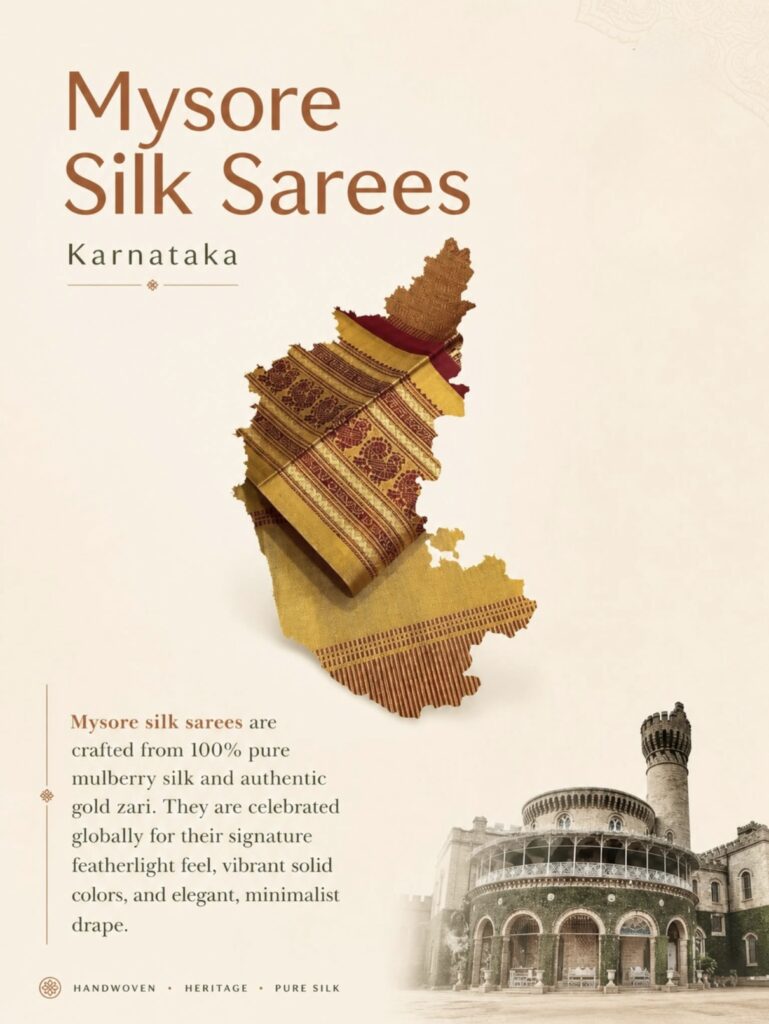
When you study the visual composition of a classic Mysore Silk Saree, framed against the geographic silhouette of Karnataka and the royal arches of Mysore Palace, one striking quality immediately commands attention: its absolute confidence in simplicity.
Notice how the rich, ochre gold field of pure mulberry silk remains unblemished by heavy surface embellishment. The entire visual authority of the garment relies on three structural choices:
- The natural, featherlight drape and luster of 100% pure silk.
- A clean, solid color field with high yarn saturation.
- A precise, contrast zari border featuring subtle geometric motifs.
The image highlights three core pillars: Handwoven. Heritage. Pure Silk.
It serves as a visual reminder that true luxury in South Asian textiles does not begin with surface decoration it begins with material purity, thread density, and exact finishing.
2. Fact Checking & Technical History of Mysore Silk
To draw meaningful leadership lessons from Mysore Silk, we must look beyond popular myths and verify its documented history, material standards, and Geographical Indication parameters.
┌─────────────────────────────────────────────────────────────────────────────┐
│                       MYSORE SILK FACTUAL STANDARDS                         │
├─────────────────────────────────────────────────────────────────────────────┤
│ • Origins: Initiated in 1780s by Tipu Sultan; formalized in 1912 by         │
│   Maharaja Nalvadi Krishnaraja Wodeyar IV via imported Swiss looms.          │
│ • GI Status: Granted GI Tag in 2005 (Karnataka Silk Industries Corp - KSIC). │
│ • Fabric Base: 100% bivoltine mulberry silk (Crepe de Chine / Georgette).  │
│ • Real Zari Composition: 65% pure silver thread coated with 0.65% 24K gold.│
│ • Unique Attribute: Featherlight drape with semi-matte crepe texture.       │
└─────────────────────────────────────────────────────────────────────────────┘
- Royal Institutional Roots: The formalization of the Mysore Silk industry occurred in 1912, when Maharaja Nalvadi Krishnaraja Wodeyar IV established the first government silk weaving factory in Mysore, importing specialized electric power looms from Switzerland. Today, this legacy is preserved under the Karnataka Silk Industries Corporation (KSIC).
- Geographical Indication : Awarded its GI tag in 2005, authentic Mysore Silk is legally defined by its production in the Mysore region of Karnataka using 100% pure mulberry silk and tested precious metal zari.
- Precious Metal Zari: A true classic Mysore silk saree features authentic zari woven with 65% pure silver thread electroplated with 0.65% 24karat pure gold.
- The Crepe de Chine Finish: Unlike stiff or heavily starched silks, Mysore silk uses high twist mulberry yarn that undergoes a specialized degumming and steam ironing process, giving it its signature fluid, featherlight drape and soft semi matte sheen.
3. Why Simplicity Requires Greater Manufacturing Discipline
In the fashion trade, it is surprisingly easy to conceal flawed fabric. If a mill uses low-density base yarn, uneven dyeing, or inconsistent weaving, it can simply cover the surface with dense embroidery, heavy sequence work, or glitter prints.
Minimalism offers no place to hide.
When a design relies on a solid color field and a single zari border, every micro flaw becomes instantly visible:
- Yarn Uniformity: A single slub or uneven twist in the warp ruins the entire drape.
- Dye Bath Consistency: Solid jewel tones demand 100% absorption consistency across thousands of meters without streakiness.
- Border Straightness: In a clean border design, even a 2mm shift in tension during weaving or processing distorts the entire silhouette.
THE MINIMALIST QUALITY PARADOX

   HEAVY EMBELLISHMENT               MINIMALIST ELEGANCE
┌─────────────────────────┐       ┌─────────────────────────┐
│ Flaws covered by sequins│       │ Flaws completely exposed│
│ Base fabric quality low │   vs  │ Requires pure yarn      │
│ High surface labor      │       │ Requires zero-defect QC │
│ Heavy & uncomfortable   │       │ Lightweight & fluid     │
└─────────────────────────┘       └─────────────────────────┘
For a modern manufacturing executive, Mysore Silk proves that creating a clean, understated product demands significantly higher engineering discipline than producing a heavily decorated one.
4. Crafting Modern Luxury: What Young Buyers Want
A common misconception among traditional traders is that young buyers Gen-Z professionals, young brides, and global Indian diaspora customers in North America, Europe, and the Middle East only want maximum embellishment for their investment.
Market reality shows the exact opposite. Modern premium customers prioritize:
- Comfort & Drapeability: They want sarees that drape in under five minutes and can be worn comfortably for eight hours straight.
- Refined Color Intelligence: They favor sophisticated tones emerald, muted gold, deep maroon, lilac, and ivory over harsh synthetic hues.
- Versatility: They seek garments that transition seamlessly from formal corporate galas to family celebrations.
- Authenticity & Restraint: They appreciate clean borders, structural integrity, and exquisite finishing over excessive plastic shine.
Modern luxury is defined by tactile comfort, movement, and visual poise.
5. Bridging Ecosystems: Karnataka’s Heritage & Surat’s Precision
The Indian textile narrative often falls into a false binary: Traditional Handloom versus Modern Machine.
As Managing Director of a Surat based manufacturing enterprise, I see these two ecosystems not as rivals, but as essential partners:
KARNATAKA SILK HERITAGE                       SURAT MANUFACTURING HUB
┌──────────────────────────────┐              ┌──────────────────────────────┐
│ • Iconic border proportions  │              │ • Advanced Jacquard technology│
│ • Material purity standards  │      +       │ • Scalable dyeing & finishing│
│ • Timeless design restraint  │              │ • Global logistics & reach   │
└──────────────────────────────┘              └──────────────────────────────┘
                               │
                               ▼
               HIGH-PRECISION PREMIUM INDIAN TEXTILES
Karnataka provides the foundational aesthetic vocabulary of Indian elegance the sacred border ratios, the color harmonies, and the commitment to material integrity.
Surat provides the advanced technology, yarn processing systems, digital jacquard precision, and operational scale required to deliver that elegance to millions of women globally at consistent quality standards.
When modern powerloom technology respects traditional design rules, technology does not replace craftsmanship it scales excellence.
6. Executive Leadership & Operational Strategy
Managing a modern premium saree enterprise demands a holistic corporate framework that balances creative vision with hard operational discipline:
[1. Trend Research & Original Art] ──► [2. Design IP & Privacy Protocols]
                                                    │
  [5. Strict Multi-Point QC]          ◄── [3. Sourcing Premium Base Fabrics]
           │                                        │
           ▼                                        ▼
  [6. Skilled Workforce Welfare]      ──► [4. Advanced Machinery & Precision]
1. Design Privacy & Originality
Plagiarism harms the industry. In an age of fast-fashion copying, we enforce strict design privacy protocols at Nari Design. Every artwork, print layout, and border draft remains encrypted and proprietary until launch, protecting our trade partners and final customers.
2. Technology Supporting Craftsmanship
We utilize high speed, high precision jacquard machinery and automated temperature controlled dye baths to eliminate batch variations. Technology handles repetitive precision, allowing our skilled technicians to focus on finishing, hand embellishment accents, and strict inspection.
3. Material First Production
Whether weaving pure silk or developing high-performance synthetic drapes, our base fabric must pass strict tensile strength, colorfastness, and softness tests before reaching production.
7. The Nari Design Philosophy
At Nari Design, our approach in Surat is guided by this exact philosophy.
We do not aim to replicate historic Mysore silks, nor do we push unnecessary surface heavy work. Instead, we apply the foundational principles of classic Indian textiles: superior base fabrics, original design artwork, disciplined color selection, and pristine edge finishing.
By combining modern European machinery with rigorous quality control, we ensure that every saree leaving our facilities represents the highest standards of Indian textile engineering.
8. The Strategic Vision for Indian Textiles
The future of premium Indian saree fashion will not be won by adding more weight, more sequins, or more superficial embellishment to a drape.
It will be won by manufacturers who understand that true luxury lies in fabric performance, proportion, precision, and restraint. When we study our heritage deeply and execute it with modern technological discipline, Indian fashion stands unmatched on the global stage.
“The future of premium sarees will not necessarily belong to the products with the most decoration. It will belong to products where fabric, colour, craftsmanship, design and finishing are brought together with extraordinary discipline.”
About the Author
Mahesh Choudhary is the Managing Director of Nari Design, premier saree manufacturing and exporting enterprises headquartered in Surat, Gujarat. A forward thinking industry leader, he focuses on original design protection, advanced manufacturing discipline, and bridging traditional Indian textile aesthetics with modern international quality standards.