By Mahesh Choudhary
Managing Director, Kimora Fashion Pvt. Ltd. & Nari Design Premium Saree India
1. Visual Analysis: The Map of a Royal Weave
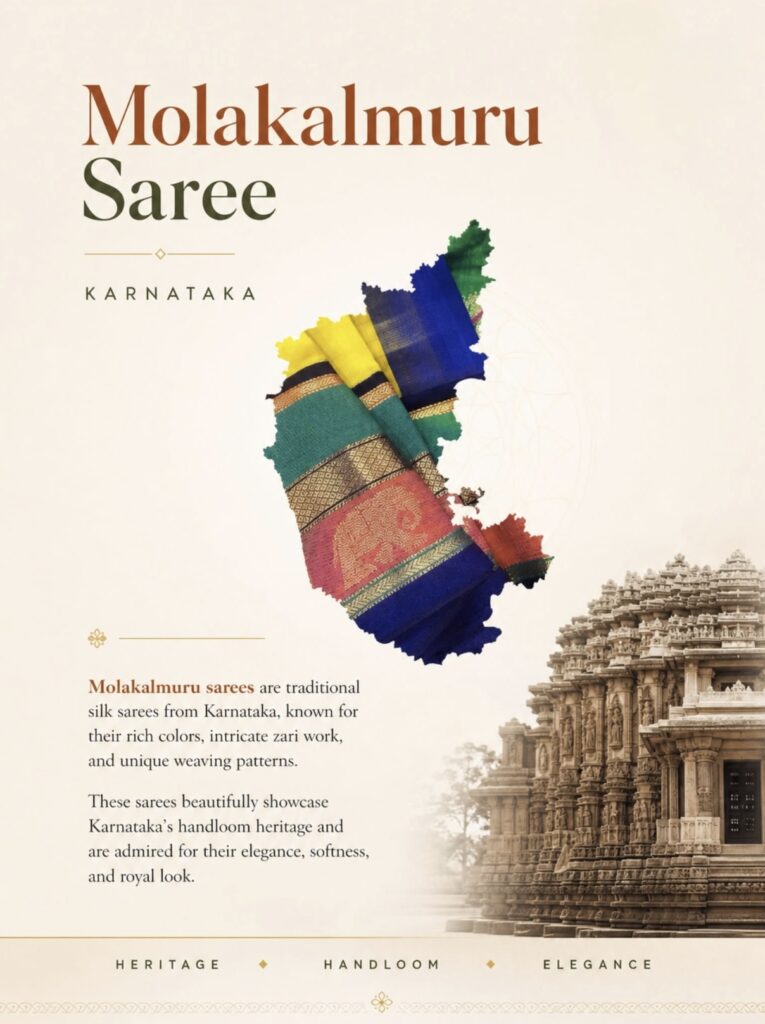
When you examine the geographic silhouette of Karnataka rendered in the brilliant hues of a Molakalmuru saree, you are looking at an architectural masterpiece folded into silk.
Notice how the emerald green field of the body meets a sharp, multi-layered contrast border in royal blue, gold, and vibrant yellow. Across the rich crimson pallu, a majestic elephant motif Gaja stands embroidered in gold zari bold, regal, and deeply rooted in South Indian temple relief sculpture.
This image embodies three words: Heritage. Handloom. Elegance.
It demonstrates that long before modern brand strategists began discussing “signature elements” or “brand identity,” India’s traditional weaving clusters had already mastered the art of visual authority through border ratios, interlocking warp contrasts, and architectural symmetry.
2. The Anatomy & Heritage of the Molakalmuru Saree
To understand why this craft holds a distinctive position in Indian textile history, one must look closely at its origin in Chitradurga district, Karnataka. Known colloquially as the “Kanchipuram of Karnataka,” the town of Molakalmuru (whose name literally translates to “broken knees” in Kannada, referencing a historical battle fought over its rocky terrain) earned its Geographical Indication (GI) status under Certificate №53.
Historians and textile researchers record that Molakalmuru weaving flourished in the 19th century under the royal patronage of Nalvadi Krishnarajendra Wodeyar, the Maharaja of Mysore. The craft developed specific, verified technical foundations:
- The Three-Shuttle Interlocking Work: An authentic Molakalmuru silk saree is traditionally woven on manual pit looms using three separate shuttles two dedicated to the solid colored contrast borders and one to the central body.
- Pure Mulberry Silk & Contrast Shot Effect: Weavers utilize pure Karnataka mulberry filature silk for the warp and charkha silk for the weft. The body features a subtle dual toned “shot effect” created by contrasting warp and weft threads, while the border and pallu maintain uniform, saturated color.
- Temple Borders & Iconography: Inspired by the Hoysala and Chalukya granite stone temples of Chitradurga, the borders feature interlocking serrated triangular patterns Kuttu or Gopuram temple motifs alongside Gaja elephant, Mayil peacock, Hamsa swan, and Kalka mango/paisley.
- Dobby and Jacquard Integration: Traditional artisans use dobby and jacquard harnesses to weave dual sided buttas that display crisp gold zari definition on both sides of the drape.
3. What Heritage Teaches Modern Saree Manufacturers
When I evaluate our production schedules in Surat, I am constantly reminded of what a traditional Molakalmuru weave teaches us about design philosophy: A great saree does not rely on superficial decoration; it relies on structural clarity.
In many commercial markets today, manufacturers confuse heaviness with luxury. They clutter a drape with excessive stone work, thick plastic glitter, and heavy zardosi to justify a price tag often hiding a cheap base fabric underneath.
A traditional Karnataka silk saree teaches us the exact opposite:
┌─────────────────────────────────────────────────────────────────────────────┐
│                    LESSONS FROM TRADITIONAL SILK WEAVES                     │
├─────────────────────────────────────────────────────────────────────────────┤
│ 1. Signature Borders: The border defines the garment's visual weight.      │
│ 2. Color Balance: Bold contrast works when yarn saturation is pure.        │
│ 3. Structural Integrity: Base fabric quality dictates how the garment drapes.│
│ 4. Motif Restraint: Spacing and proportion create elegance, not density.     │
│ 5. Authenticity: True value comes from precision, finish, and material integrity.│
└─────────────────────────────────────────────────────────────────────────────┘
4. Two Ecosystems, One Shared Vision
A common debate in the fashion industry pits handloom handcraft against powerloom manufacturing, framing them as ideological enemies. As an executive operating from Surat the modern textile manufacturing capital of India I view this dynamic differently.
Karnataka’s handloom clusters and Surat’s manufacturing ecosystem represent two halves of India’s textile genius:
KARNATAKA HERITAGE ECOSYSTEM                  SURAT MANUFACTURING ECOSYSTEM
┌───────────────────────────────────┐        ┌───────────────────────────────────┐
│ • Centuries of handloom heritage  │        │ • High-speed Jacquard precision   │
│ • Iconic regional border ratios   │   +    │ • Advanced processing & dyeing    │
│ • Sacred temple geometry & motifs │        │ • Scalable digital print systems  │
│ • Unmatched artisanal knowledge   │        │ • Global trade & logistics reach  │
└───────────────────────────────────┘        └───────────────────────────────────┘
                                      │
                                      ▼
                        SUSTAINABLE PREMIUM LUXURY
Neither ecosystem is superior. Karnataka preserves the original artistic identity and cultural soul of Indian textiles. Surat provides the processing infrastructure, yarn engineering, color precision, and scalable capacity to deliver high quality apparel to millions of women worldwide.
When modern manufacturers study regional handloom geometry and apply those structural rules to high-precision processing, modern machinery does not erase regional identity. It makes regional aesthetics accessible, wearable, and globally viable.
5. Executive Leadership: The Managing Director’s Strategic Role
Operating a modern manufacturing enterprise like Nari Design requires far more than monitoring daily output or managing merchant trading.
A modern Managing Director must connect design, technology, people, finance, and quality control into a single, disciplined system:
[1. Market Trends & Consumer Data] ──► [2. Original Design IP] ──► [3. Premium Yarn Sourcing]
                                                                               │
  [6. Rigorous Multi-Tier QC]        ◄── [5. Disciplined Production]  ◄── [4. Advanced Machinery]
           │
           ▼
  [7. Design Privacy Controls]      ──► [8. Skilled Workforce Care]   ──► [9. Global Supply Reach]
1. Protecting Original Design & Intellectual Property
Plagiarism is a systemic problem in the textile trade. A team spends months developing a new border or print, only for low-quality copies to flood the market within days. At Nari Design, we invest heavily in in-house artwork, proprietary weave layouts, and strict design privacy protocols before launch.
2. Fabric, Softness, and Finishing Standards
You cannot hide weak yarn under surface embellishment. A premium saree must feel exceptional against the skin. We maintain zero defect standards across yarn selection, soft finish processing, border alignment, and edge finishing.
3. Caring for the Skilled Workforce
Whether operating a manual loom in Chitradurga or a high-speed jacquard unit in Surat, skilled humans remain the backbone of the industry. Respecting our technicians, artisans, and production teams through safe working conditions and fair compensation directly translates to product excellence.
4. Management Equation
The core executive philosophy can be summarized as:
{Original Design} {Material Integrity} {Advanced Tech} {Strict QC} {Sustainable Industry Vision}
6. Evolving Preferences: The Modern & Global Consumer
Younger Indian women, Gen-Z brides, and global diaspora buyers in cities like London, Dubai, New York, and Toronto are not turning away from traditional sarees. They are turning away from uncomfortable, heavy, and impractical garments.
Today’s consumer looks for:
- Lightweight Drapes: High visual impact with comfortable, effortless movement.
- Refined Palettes: Sophisticated jewel tones, soft pastels, and clean metallic contrasts that style easily for daytime events or evening galas.
- Versatile Styling: Garments that pair effortlessly with tailored blouses, crop tops, blazers, or minimal jewelry.
- Authentic Storytelling: She wants to know the history behind the border, the significance of the motif, and the care put into crafting her garment.
When we present regional heritage like the bold borders of Molakalmuruthrough contemporary drapes, soft fabrics, and pristine finishing, traditional wear becomes a modern fashion choice.
7. The Nari Design Philosophy
At Nari Design in Surat, this philosophy guides every collection we produce.
We do not pretend to be traditional handloom weavers from Karnataka. Instead, we act as respectful custodians of Indian design principles. We study the geometric ratios, color harmonies, and border proportions of historic regional weaves, translating those ideas into contemporary, high quality collections using modern fabric technology and disciplined production systems.
By maintaining strict quality control, protecting our design privacy, and supporting trade partners with reliable delivery schedules, we deliver designer sarees that honor tradition while powering the modern retail market. A premium saree is the final result of a premium ecosystem.
8. The Future of Indian Textiles
The path forward for Indian textiles does not require a choice between handloom heritage and technological advancement.
Karnataka’s historic looms remind us of where our visual identity was born. Surat’s modern manufacturing hubs demonstrate how far our production capability can reach. When we bring these two worlds together through original design, advanced technology, disciplined craftsmanship, unyielding quality, and intelligent management, we build an industry that leads global fashion.
“The future of India’s premium saree industry will not come from abandoning heritage. It will come from understanding heritage deeply, protecting its identity, and giving it new relevance through original design, technology, craftsmanship, quality, and intelligent management.”
About the Author
Mahesh Choudhary is the Managing Director of Nari Design, leading premium saree manufacturing enterprises based in Surat, Gujarat. Recognized for his strategic vision in textile manufacturing, Mahesh focuses on bridging India’s rich regional heritage with modern technology, original design development, and professional management systems.