By Mahesh Choudhary
Managing Director, Nari Design Premium Saree India
1. Visual Analysis: The Map of a Design Identity
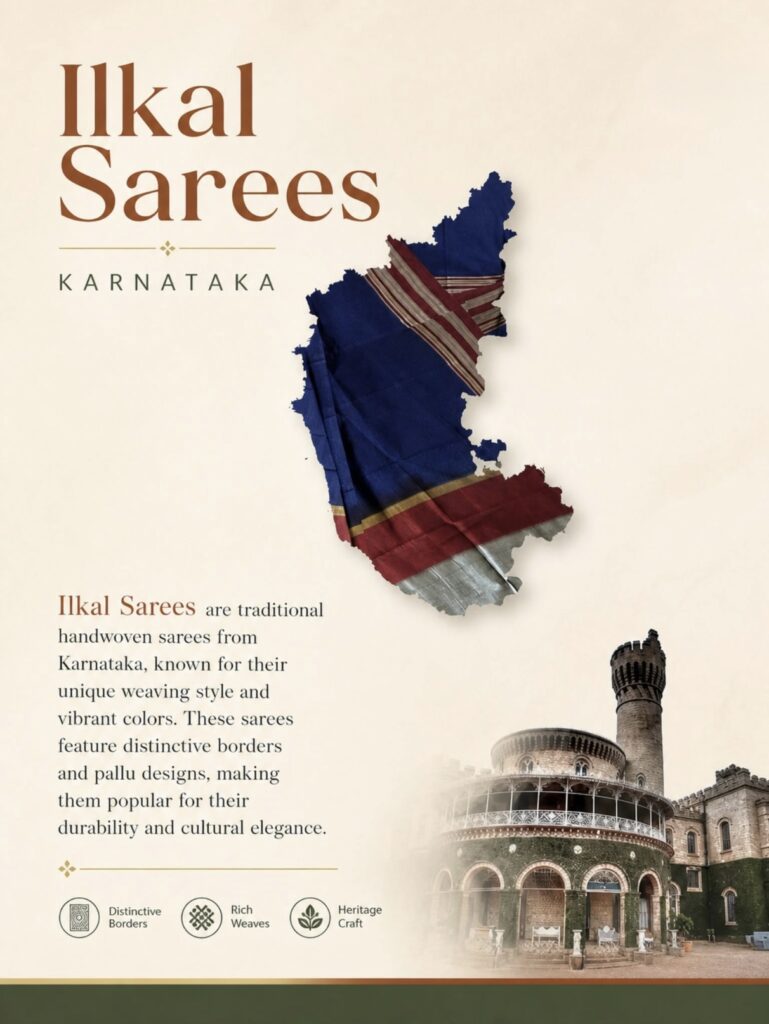
When you look at the silhouette of Karnataka rendered in the deep indigo and crimson of an Ilkal saree, you are seeing more than a geographic boundary. You are looking at a living canvas where a town’s name has become synonymous with a visual language.
The deep blue field of the body, crisp and unpretentious, meets a structured border in rich maroon red. Running across the top, the iconic Tope Teni pallu displays its signature alternating bands of red and white a striking contrast that has endured for centuries.
Notice how the fabric behaves: it does not rely on heavy surface embellishment, thick zardosi, or dramatic gold sheeting. Its authority comes entirely from structural geometry, color placement, and yarn tension.
When a regional textile reaches this level of clarity, something remarkable happens: the place stops being just a coordinate on a map and becomes a distinct design identity.
2. The Anotomy of an Authentic Ilkal Saree
Originating in the historic weaving hub of Ilkal in Bagalkot district, North Karnataka, this craft dates back to the 8th century AD, flourishing under the patronage of local chieftains and royal dynasties across the Deccan. Recognized with a Geographical Indication (GI) tag, the authentic Ilkal saree is built on specific, verified technical foundations:
- The Tope Teni Warp Interlocking: Unlike standard sarees where the body and pallu are woven continuously from a single warp, an authentic Ilkal saree joins a cotton body warp with a pure silk or art silk pallu warp using a series of interlocking loop joins called Tope Teni. This technique is completely unique to Ilkal weaving.
- The Kondi Weft Insertion: To create the solid, contrasting borders that define the saree, weavers use three separate shuttles in a technique known locally as Kondi.
- The Tope Teni Seragu (Pallu): The traditional pallu pattern features three solid red bands separated by two white bands. Historically regarded as a symbol of dignity across Karnataka, the middle section sometimes features temple tower motifs Hanige or comb designs, and Rampa mountain crests.
- Signature Borders: Ilkal borders are broad 2.5 to 6 inches and structured. They are traditionally woven in four iconic styles: Gomi also known as Ilkal dadi, resembling a chevron or grain motif, Paraspet including Chikki Paras, Jari, and Gadi.
- The Material Combination: Traditionally woven with a high-count cotton body giving breathability in the dry heat of the Deccan plateau and a silk warp border and pallu giving visual richness where the garment drapes over the shoulder.
- Cultural Color Language: Colors are bold, grounded, and symbolic pomegranate red, peacock green, indigo, dark purple, and Giri Kumkum the sacred vermilion red reserved for bridal ceremonies.
3. What Modern Saree Manufacturers Can Learn From Ilkal
In today’s fast-moving market, design teams often confuse more decoration with higher value. We see sarees loaded with heavy handwork, thick glitter, and cluttered embroidery often hiding a weak base fabric or poor color harmony underneath.
The Ilkal saree teaches us the exact opposite: true luxury lies in proportion, contrast, and structural integrity.
┌─────────────────────────────────────────────────────────────────────────────┐
│                       LESSONS FROM THE ILKAL HERITAGE                       │
├─────────────────────────────────────────────────────────────────────────────┤
│ 1. Signature Elements: One or two recognizable details create longevity.   │
│ 2. Uncompromising Proportion: Border width must balance body density.        │
│ 3. Intelligent Color: Contrast works best when grounded in classic tones.   │
│ 4. Fabric-First Discipline: The drape and touch matter more than ornament.  │
│ 5. Authenticity over Clutter: Simplicity requires higher manufacturing skill.│
└─────────────────────────────────────────────────────────────────────────────┘
When a saree relies on clean lines, a strong border, and a well-finished drape, it does not go out of style next season. It becomes a timeless staple.
4. Two Ecosystems, One Shared Goal: Handloom Heritage and Modern Manufacturing
There is an old debate in Indian fashion that places handloom weaving and modern manufacturing in opposition. Some view handloom as authentic and machine production as commercial. Others view handlooms as slow and modern factories as efficient.
As someone operating from Surat the textile manufacturing engine of India I see these two ecosystems not as rivals, but as complementary partners.
KARNATAKA HANDLOOM STRENGTHS                 SURAT MANUFACTURING ECOSYSTEM
┌───────────────────────────────────┐        ┌───────────────────────────────────┐
│ • Intricate warp interlocking     │        │ • High-speed precision looms      │
│ • Unmatched human artistry        │   +    │ • Advanced processing & dyeing    │
│ • Deep cultural symbolism         │        │ • Scalable digital print systems  │
│ • Generations of weaver knowledge │        │ • Global supply chain logistics   │
└───────────────────────────────────┘        └───────────────────────────────────┘
                                      │
                                      ▼
                        SUSTAINABLE PREMIUM FASHION
Karnataka’s traditional weaving clusters preserve the ancestral knowledge of thread geometry and regional identity. Surat provides the processing capacity, yarn engineering, high precision electronic looms, advanced finishing ranges, and global trade connections required to serve millions of women worldwide.
When modern textile machinery is used with respect for traditional design rules maintaining proper border ratios, color depth, and fabric softness it does not erase regional identity. It makes regional aesthetics accessible at a scale and price point that keeps the saree relevant in daily life.
5. Executive Perspective: Originality, Discipline, and Quality Management
Managing a modern manufacturing enterprise like Nari Design requires looking past short term market trends. True industrial leadership in fashion demands strategic discipline across several core areas:
1. The Trap of Design Copying
The Indian textile market is often plagued by rapid design plagiarism. A manufacturer creates an original concept, and within weeks, dozens of cheap, poorly finished copies flood the market. At Nari Design, our philosophy is clear: copying destroys long term brand equity. True premium positioning requires investing in in house textile designers, original artwork, and protected pattern development.
2. Fabric and Finishing over Surface Decoration
You cannot hide poor yarn quality under heavy embroidery. A premium saree must feel good the moment it touches the skin. We focus heavily on yarn density, soft finish processing, colorfastness, and edge-stitching so that the saree drapes effortlessly without feeling stiff or heavy.
3. Manufacturing Privacy and Quality Control
Quality management is not an inspection done at the end of the line it is a discipline applied at every stage. From yarn procurement and loom tension monitoring to grey fabric inspection and final packaging, every step must meet strict standards. Protecting design privacy before a collection launches ensures our trade partners receive exclusive, high-value collections.
4. A Balanced Management Equation
A Managing Director cannot simply be a merchant or a production manager. Modern textile leadership requires a balanced management framework:
{Original Design} {Yarn Integrity} {Modern Technology} {Disciplined QC} {Sustainable Luxury}
6. Rethinking Premium: Why Heavy Does Not Mean High Value
For years, the Indian market was driven by the idea that a heavy saree was automatically a premium saree. If a bride or wedding guest paid a high price, she expected heavy zari, dense stone work, or thick handwork across every inch of the fabric.
Today’s consumer especially younger women, Gen-Z brides, and global diaspora buyers has completely shifted this dynamic:
- Comfort is Non Negotiable: A woman attending a 6 hour wedding or corporate festive gala wants a drape that moves with her, not a garment that weighs 3 kilograms.
- Proportion over Density: A clean, contrasting border with a well balanced body creates a more regal, sophisticated silhouette than cluttered overall decoration.
- Contemporary Styling: Modern women are pairing traditional drapes with crisp blouses, tailored jackets, minimal metallic jewelry, or belt accents.
- Global Portability: For international buyers in New York, London, or Dubai, lightweight premium sarees pack easily, drape smoothly, and transition seamlessly between daytime rituals and evening receptions.
Premium fashion is not defined by weight. It is defined by the quality of the yarn, the precision of the weave, the harmony of the colors, and the elegance of the finish.
7. The Nari Design Philosophy
At Nari Design, operating from our manufacturing base in Surat, this mindset guides our daily work.
We do not claim to replace traditional handloom clusters like Ilkal. Instead, we study the principles that made these weaves iconic their bold border structures, their intelligent use of contrast, their clean geometric lines and translate those principles into contemporary, high quality collections using modern fabric processing and structured manufacturing.
By maintaining strict quality controls, original artwork, and scalable production schedules, we deliver designer sarees that respect traditional aesthetics while serving the needs of modern retail chains and export markets. A premium saree is the final result of a premium ecosystem.
8. The Future of Indian Textile Heritage
The future of India’s textile identity will not be built by choosing between handloom tradition and modern manufacturing. Nor will it be built by abandoning our heritage to follow fleeting Western trends.
It will be built by understanding our regional crafts deeply their history, their geometry, their proportions and giving them new life through original design, modern technology, disciplined manufacturing, and visionary management.
When we respect the DNA of regional crafts like the Ilkal saree and present them with modern quality and contemporary drape, we ensure that India’s textile heritage remains not just a proud memory of the past, but a dominant force in global fashion.
About the Author
Mahesh Choudhary is the Managing Director of Nari Design, leading premium saree manufacturing enterprises based in Surat, Gujarat. A veteran industry leader, Mahesh advocates for professional management, design originality, and modern technological integration across the Indian textile industry.