By Mahesh Choudhary
Managing Director, Nari Design Premium Saree India
1. Visual Analysis: The Map of Woven Heritage
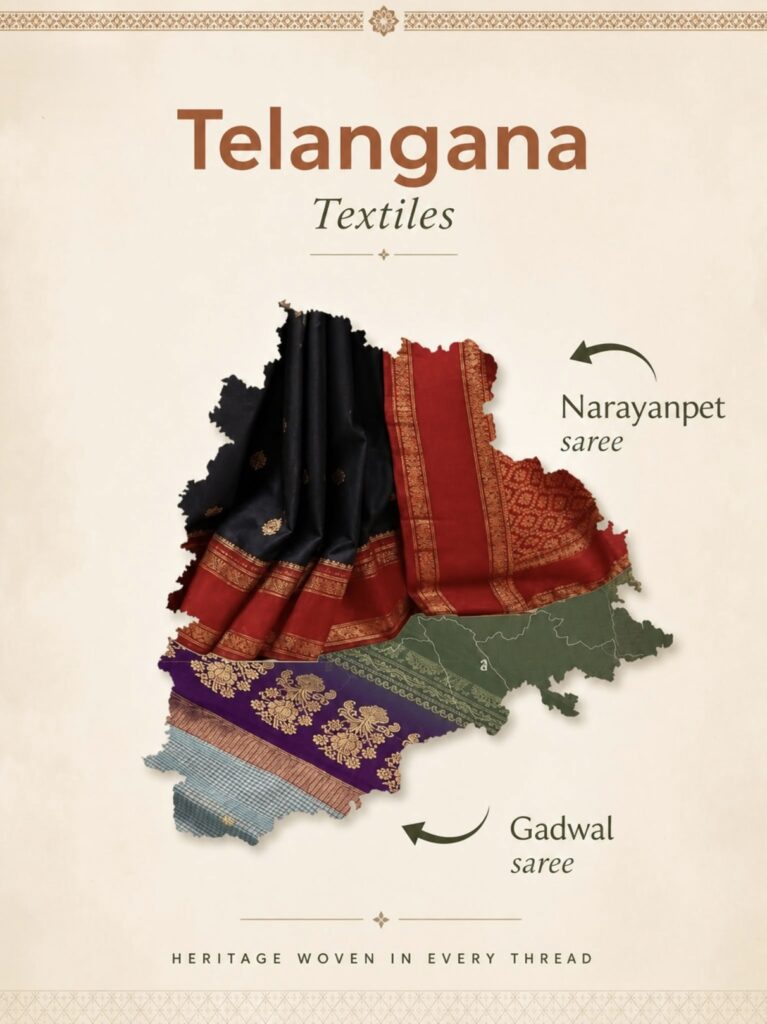
When you examine the visual map of Telangana’s textile traditions, two distinct master weaves immediately command attention under the tagline “Heritage Woven in Every Thread”.
On the northern canvas of the region lies the Narayanpet saree draped in a commanding, jet black field juxtaposed against a deep crimson red border. Its golden zari motifs are spaced with geometric discipline across the body, flanked by the iconic temple border design whose sharp triangular crests echo Deccan architectural stone carvings.
Directly below, the Gadwal saree represents an entirely different structural philosophy. Draped in rich royal purple and silver grey tones, its body presents intricate floral and paisleys woven in golden brocade zari. The contrast border and heavy pallu display elaborate inter locked patterns that demonstrate centuries of hybrid weaving mastery.
Together, these two regional treasures encapsulate a profound truth about Indian textiles: a saree is never just a garment. It is a geographic, architectural, and mathematical artifact.
2. Deep Roots: History and Craftsmanship of Telangana’s Weaves
The Narayanpet Tradition: Maratha Lineage in the Deccan
Historical records trace the origins of Narayanpet weaving to the 16th century, around 1630 AD, during the campaign of Maratha king Chhatrapati Shivaji Maharaj in the Deccan region. Legend and local history record that when the Maratha army halted in the Narayanpet region (now in the Narayanpet district of Telangana), a group of weavers accompanying the camp decided to settle permanently.
- Materials & Technique: Traditionally woven using fine-count cotton (80s to 100s count) or silk cotton blends. The signature feature is the interlocked welt border (Ganga Jamuna style when dual toned) and the prominent temple border (Gomi or chevron design).
- Distinctive Character: Lightweight, extremely durable, and defined by dark, rich earthy hues deep reds, forest greens, indigo blues, and dense blacks. The vegetable dye traditions historically gave Narayanpet sarees their non-fading structural depth.
- Cultural Significance: Historically worn during sacred ceremonies and daily rituals across Maharashtra, Karnataka, and Telangana, serving as a functional bridge between Maratha utility and Deccan sacred aesthetics.
The Gadwal Tradition: Royal Engineering & Hybrid Weaving
Originating from the historic kingdom of Jogulamba Gadwal, this weave developed under the direct royal patronage of the Gadwal rulers (Samsthanams) in the 17th and 18th centuries.
- Materials & Engineering: Gadwal sarees are famous for their unique hybrid construction: a lightweight, breathable cotton body attached to a rich silk border and pallu woven with heavy pure gold or silver zari.
- The Kutu (or Kumbam) Technique: Joining a cotton warp/weft body to a silk border requires a complex hand-interlocking weave called Kutu. The joint is so structurally sound that the saree retains tensile strength across differing fiber tensions.
- Distinctive Character: The entire cotton body can be folded to the size of a matchbox, yet when draped, the heavy silk pallu and border lend the wearer the majestic presence of royal court attire.
3. The Core Tension: Preservation vs. Innovation
As someone who spends every day analyzing textile supply chains, design development, and consumer behavior, I often observe a fundamental debate in our industry: How do we preserve India’s regional textile heritage without turning it into a museum piece?
There is a natural tension between:
- Preservation & Innovation: Static preservation treats heritage as untouchable, which risks rendering it obsolete to younger generations. True innovation respects the original DNA while adapting weight, drape, and palette to modern lifestyles.
- Craftsmanship & Technology: Handlooms represent irreplaceable human touch and cultural memory. Modern high speed looms and processing units represent consistency, scale, and accessibility. They do not need to destroy each other they can inform each other.
- Regional Identity & Global Fashion: A saree rooted deeply in a single district can easily become a global statement piece if translated into contemporary design language.
If a 200 year old textile technique remains uncomfortable to wear in a warm destination wedding or takes months to produce in unpredictable quantities, the modern consumer will inevitably turn elsewhere. Preservation without adaptation leads to stagnation.
4. Telangana’s Artistry vs. Surat’s Manufacturing Powerhouse
To understand where Indian fashion is heading, we must analyze two complementary powerhouses of Indian textiles:
┌──────────────────────────────────────────────┬──────────────────────────────────────────────┐
│       TELANGANA'S REGIONAL WEAVING           │        SURAT'S MODERN ECOSYSTEM              │
├──────────────────────────────────────────────┼──────────────────────────────────────────────┤
│ • Centuries of handloom heritage             │ • Unmatched processing & dyeing infrastructure│
│ • Iconic regional motifs & sacred geometry    │ • High-speed Jacquard & embroidery systems   │
│ • Intricate yarn interlocking (Kutu/Korvai)  │ • Scalable digital printing & fabric blends  │
│ • Uncompromising material integrity          │ • Global supply chain & rapid prototyping    │
└──────────────────────────────────────────────┴──────────────────────────────────────────────┘
Telangana provides the soul, symbolism, and structural identity. Surat provides the scale, speed, precision, and global reach.
When a manufacturer in Surat studies the geometric balance of a Narayanpet temple border or the material contrast of a Gadwal Kutu weave, the goal is not to counterfeit handlooms. The goal is to absorb those timeless principles of balance, contrast, and motif density, and re engineer them using world class fabric technology, precision dyeing, and structured manufacturing.
5. The Blueprint of Modern Premium Saree Manufacturing
Creating a true premium saree in today’s market demands far more than buying fabric and applying embellishments. It requires an integrated ecosystem based on nine non negotiable pillars:
[1. Heritage Insights] ──► [2. Original Design] ──► [3. Premium Yarn/Fabric]
                                                               │
  [6. Quality Control]   ◄── [5. Disciplined Production] ◄── [4. Advanced Tech]
           │
           ▼
  [7. Design Privacy]   ──► [8. Skilled Workforce] ──► [9. Visionary Management]
- Heritage Deeply Understood: Studying historical weaves so that motifs maintain correct proportion and balance.
- Original Design: Investing in dedicated in house art directors and textile designers rather than copying market samples.
- Premium Fabrics: Utilizing high denier silks, breathable cotton-poly blends, and eco friendly yarns that feel luxurious against the skin.
- Technology Integration: High precision looms, electronic jacquards, and automated color matching systems to eliminate batch variations.
- Disciplined Manufacturing: Strict adherence to production schedules, tension management, and weaving speeds.
- Rigorous Quality Control: Multi tier inspection covering yarn consistency, color fastness, border alignment, and finishing.
- Design Privacy & Intellectual Integrity: Protecting original artwork and patterns to maintain brand exclusivity in the luxury market.
- Skilled Workforce Care: Treating artisans, machine technicians, and master weavers as essential partners in production.
- Visionary Management: Aligning every operational unit toward a unified long term vision.
6. Executive Leadership: The Managing Director’s Strategic Perspective
In the traditional textile trade, leadership was often limited to merchant trading buying low, selling high, and managing stock. In modern premium apparel, that mindset is obsolete.
As Managing Director at Nari Design, my daily focus extends far beyond loom output or yardage:
- Managing Design & Intellectual Property: Ensuring our creative teams push boundaries while protecting original print and weave designs from market plagiarism.
- People & Skill Cultivation: Building an environment where master artisans, digital textile engineers, and logistics managers work with shared pride and accountability.
- Technology Investments: Upgrading processing machinery, digital printing systems, and ERP infrastructure to maintain zero defect standards.
- Financial Discipline & Supply Chain Logistics: Balancing raw material procurement with market demand, ensuring timely deliveries across India and international trade channels.
- Customer Understanding: Analyzing shifting trends among Gen-Z brides, working professionals, and global diaspora buyers who demand lightweight drapes, pastel palettes, and instant wearability.
“A premium saree is never an accident of production. It is the calculated end result of a well managed fashion ecosystem.”
7. Connecting the Modern Consumer and Global Diaspora
Younger Indian women and international customers are not rejecting the saree; they are rejecting impracticality.
When a Gen-Z bride or a professional in London, Dubai, or New York looks for a saree, she seeks:
- Lightweight Drapes: High-density aesthetic appeal without physical discomfort.
- Contemporary Palettes: Muted pastels, deep jewel tones, and sophisticated metallic accents that style effortlessly with modern blouses or blazers.
- Authentic Storytelling: She wants to know the story behind the weave why the border has temple motifs, what the color symbolizes, and how the garment was crafted.
By presenting regional Indian aesthetics like the architectural lines of Narayanpet or the contrast brilliance of Gadwal through refined contemporary fabrics, modern quality standards, and honest storytelling, we transform traditional clothing into a global fashion category.
8. The Path Forward
The future of India’s textile industry does not require us to choose between heritage and technology.
Telangana’s historic looms remind us of where our aesthetic identity began. Surat’s modern textile ecosystem demonstrates where our manufacturing capability can go. When we connect these two worlds with original design, modern technology, unyielding quality control, and visionary management, we ensure that the Indian saree remains an enduring symbol of luxury on the global stage.
About the Author
Mahesh Choudhary is the Managing Director of Nari Design, leading premium saree manufacturing enterprises based in Surat, Gujarat. A veteran industry leader, Mahesh focuses on bridging India’s rich textile heritage with state of the art manufacturing systems, professional design management, and global distribution.